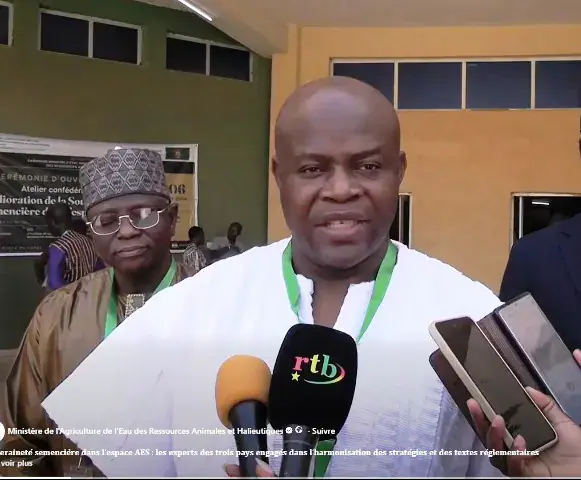
The Secretary General of Burkina Faso's Ministry of Agriculture, Water, Animal and Halieutic Resources, Gaoussou Sanou, chaired a meeting of experts from the seed systems of Burkina Faso, Mali, and Niger on November 3, 2026, in Ouagadougou. The goal is to establish a harmonized seed system for the Confederation of Sahel States (AES) to strengthen food sovereignty. The meeting aims to validate a report on the horizons of the confederal seed sector and develop a strategy for its development.
The four-day workshop brought together experts, including the Secretary General of Niger's Ministry of Agriculture and Livestock, Ousman Abdou, and the technical advisor to Mali's Minister of Agriculture, Tiéman Traoré. Participants will study and validate the report, strategy, and regulatory texts governing agricultural, animal, and halieutic seeds. The objective is to increase agricultural, animal, and halieutic production to achieve food and nutritional sovereignty by 2031.
Gaoussou Sanou emphasized that the majority of the AES member countries' populations depend directly on the agro-sylvo-pastoral and halieutic sectors for their livelihoods. Therefore, making these sectors more productive and competitive is a significant challenge. Sanou highlighted that improved seeds and breeds are crucial factors, contributing around 40% to yield increases. Their availability, quality, and accessibility must be guaranteed.
Ousman Abdou, Secretary General of Niger's Ministry of Agriculture and Livestock, expressed hope that this initiative will liberate the AES space. He stressed that seeds are the foundation of agricultural production and can also be a source of harm if not properly managed. Abdou called for a robust system to secure seeds and create a safety stock, ensuring food sovereignty.
Inoussa Ouédraogo, President of the Alliance of Sahel Seed Producers (APSS), emphasized that food sovereignty begins with quality seeds. He urged stakeholders to own the document and support seed production, a guarantee of food sovereignty in the AES space. The strategy for developing the seed sector is justified by the protocol additional to the treaty creating the AES confederation.
The meeting's outcome is expected to align with the expectations of authorities and stakeholders. The strategy's implementation will rely on the developed documents, ensuring a harmonized seed system for the AES member countries. This initiative aims to increase food production, securing the livelihoods of millions of people in the region.
The AES member countries are taking concrete steps towards achieving food sovereignty. By harmonizing their strategies and regulations, they can leverage their collective strengths to address food security challenges. The Ouagadougou meeting marks a significant milestone in this effort, demonstrating the commitment of AES member countries to ensuring a food-secure future.
Key points
- Experts from Burkina Faso, Mali, and Niger met to harmonize agricultural strategies and regulations.
- The goal is to establish a harmonized seed system for the Confederation of Sahel States (AES) to strengthen food sovereignty.
- The strategy aims to increase agricultural production and achieve food and nutritional sovereignty by 2031.