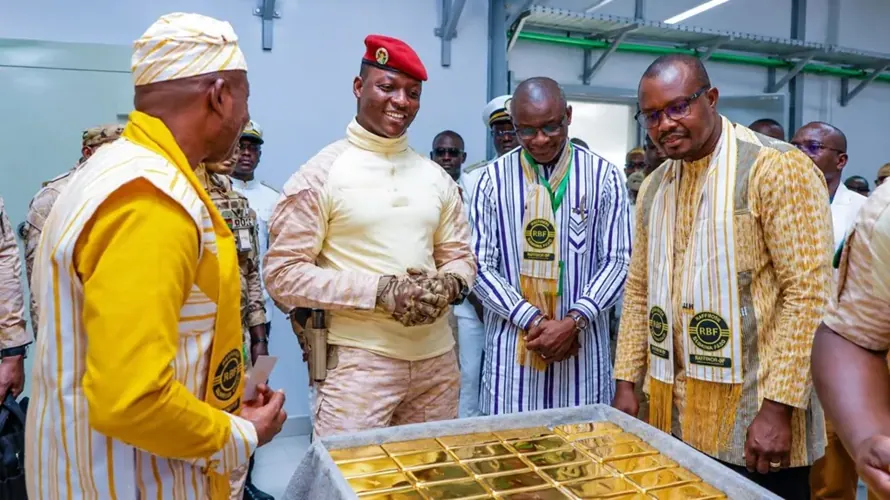
Burkina Faso has inaugurated its first gold refinery, marking a significant step towards processing more of its mineral wealth domestically. The military-led government, under junta leader Ibrahim Traoré, aims to end the country's reliance on exporting raw materials for processing abroad. The refinery, known as Raffinor-BF, was opened in the capital, Ouagadougou, on Monday, September 30, 2026.
The new facility is part of a broader effort to tighten control over one of Burkina Faso's most important industries. Traoré stated that the goal is to refine all metals on site and have the entire value chain locally. Burkina Faso is one of Africa's largest gold producers, but the authorities have faced challenges in regulating the informal mining sector, which has been affected by jihadist violence.
The government hopes the refinery will turn Burkina Faso into a regional gold-refining hub. With gold production on the rise, the government established a state-owned mining company two years ago. Foreign mining firms are now required to give the state a 15% stake in their operations and train local workers. This move is expected to increase local participation and control in the mining sector.
According to the World Gold Council, Burkina Faso's gold output rose by 17% year-on-year in the second quarter of 2026, driven by increased production at several mines. However, successive governments have struggled to regulate the country's extensive artisanal and small-scale mining industry, where smuggling and informal trading have made it difficult to account for all the gold produced.
The government has also alleged that some illegally traded gold helps finance the Islamist insurgency that has engulfed much of the country. Burkina Faso has been fighting armed Islamist groups linked to al-Qaeda and Islamic State for years, with large areas outside full government control. The new refinery is expected to help address these challenges by providing a more controlled and transparent environment for gold processing.
The Raffinor-BF refinery cost over 11bn CFA francs ($19m; £14m) and was financed by the state, including through the National Precious Metals Company (Sonasp), in partnership with Burkina Faso's private sector. The plant will initially be capable of refining 164 tonnes of gold a year, significantly more than the country's current annual production. The government plans to increase the refinery's capacity to 515 tonnes, suggesting it also wants to process gold from elsewhere in the region.
The launch of the refinery marks a significant milestone in Burkina Faso's efforts to develop its mining sector and increase local value addition. The government aims to create a regional gold-refining hub and improve control over the industry. The project is expected to have a positive impact on the country's economy and help address the challenges posed by informal mining and jihadist violence.
Key points
- Burkina Faso opens its first gold refinery to process mineral wealth locally
- The refinery aims to produce 164 tonnes of gold a year, with a potential capacity of 515 tonnes
- The project is part of a broader effort to tighten control over Burkina Faso's mining sector and reduce reliance on exporting raw materials abroad