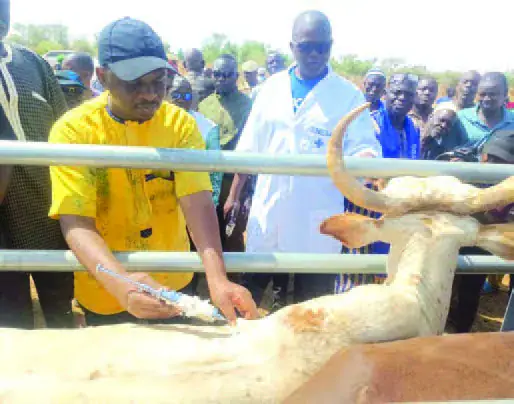
The Burkinabé government has initiated a nationwide animal vaccination and artificial insemination campaign for 2026-2027. Minister of Animal Resources Amadou Dicko led a supervision mission from November 10-12, 2026, in the Nazinon, Oubri, and Yaadga regions. The campaign aims to combat priority animal diseases and improve the national livestock's genetic potential. Dicko was accompanied by key officials, including the Director-General of Veterinary Services, Aboubacar Nacro, and Ardiouma Sirima, Director-General of the Center for Poultry Promotion and Multiplication of Performant Animals.
The campaign's objectives include controlling animal diseases and enhancing livestock productivity. Minister Dicko reported a satisfactory outcome in the visited areas, marking the fourth large-scale vaccination campaign conducted by the government. The goal is to master most animal pathologies by reducing their impact and eradicating some by 2030. The minister emphasized the mandatory nature of animal vaccination, warning of sanctions against non-compliant producers. He also highlighted the government's substantial investments in animal health, including constructing a national vaccine production unit and operationalizing a veterinary medicine purchasing center.
In the Nazinon region, the Director-General of Veterinary Services, Captain Aboubacar Nacro, expressed satisfaction with the mid-term results. He noted significant progress in small ruminant vaccination, with approximately 300,000 heads vaccinated against Peste des petits ruminants (PPR) and pasteurellosis. These achievements demonstrate the commitment of technical teams and producers. Meanwhile, in Oubri, Ardiouma Sirima reported a strong interest in artificial insemination among breeders, with nearly 650 cows inseminated. This process is now coupled with digital identification using RFID technology to enhance animal tracking and genetic improvement.
The artificial insemination program aims to improve the national herd's genetic potential and increase meat and milk production. Sirima clarified that consultations with religious leaders have been conducted, and no religious prescription prohibits this modern practice. The program contributes to strengthening food sovereignty. Producers have welcomed the government's efforts, citing reduced vaccination costs and improved herd yields. In Toécé, Nazinon region, Conseiller villageois de développement Marou Ilboudo praised the campaign's impact on animal survival, noting a significant decrease in animal mortality.
Breeders have expressed their gratitude for the government's support. Adou Barry, an breeder from Sondré-Est, highlighted the benefits of having a local vaccination center and subsidized products. Previously, breeders had to travel long distances for vaccination. Issa Compaoré, a breeder from Bangré-Saanga, Oubri region, noted that artificial insemination, which previously cost 75,000 F CFA, is now accessible at 5,000 F CFA thanks to government subsidies. He reported increased milk production and better animal health.
The campaign's success is attributed to the collaboration between government agencies, local authorities, and breeders. Minister Dicko announced a mid-term review workshop on November 27, 2026, to assess progress and formulate recommendations. The government has made significant investments in animal health infrastructure, including a national vaccine production unit and regional veterinary medicine purchasing centers. These efforts aim to ensure the long-term sustainability of animal health services.
The vaccination and insemination campaign aligns with the 2026-2028 Agro-Pastoral, Hydraulic, and Fisheries Offensive. By improving animal health and productivity, the government aims to enhance food security and contribute to economic growth. The campaign's outcomes will be closely monitored, with a focus on sustaining momentum and addressing emerging challenges.
Key points
- The Burkinabé government has launched a nationwide animal vaccination and artificial insemination campaign for 2026-2027.
- The campaign aims to control animal diseases and enhance livestock productivity.
- The government has invested in animal health infrastructure, including a national vaccine production unit and regional veterinary medicine purchasing centers.