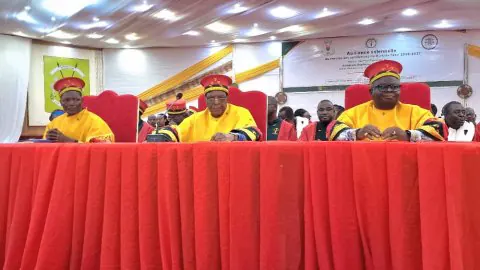
The judicial reform in Burkina Faso for the 2026-2027 period is centered on incorporating traditional mechanisms for resolving disputes to enhance access to justice. This approach aims to bring the judicial institution closer to the social and cultural realities of the country while maintaining the guarantees associated with the rule of law. The theme for this year's reform is "The contribution of traditional mechanisms for resolving disputes for better access to justice in Burkina Faso." The event took place on October 2, 2026, under the patronage of President Ibrahim Traoré.
According to Pascal Bamouni, President of the Court of Cassation, this reform reflects a desire to reappropriate cultural and legal aspects. He emphasized that it is not a simple return to the past but a step towards creating a more accessible and nationally rooted justice system. Bamouni highlighted that traditional mechanisms of conflict resolution prioritize dialogue, reparation, and reintegration of parties within the community, differing from a strictly punitive logic.
Batibié Benao, President of the Bar Association, shares the view that the law can only be effective if it draws from the society that organizes collective life. He noted that customs practiced in villages, under trees, or before chiefs and elders have been progressively framed by the legislator. Benao explained that these customs have been given legitimacy, then filtered by principles, prohibitions, and controls, before being given the form and force of law.
Edasso Rodrigue Bayala, Minister of Justice, expressed optimism about the reform, stating that involving traditional instances will accelerate citizens' access to justice. He affirmed that the actors have appropriated this reform and are ready to accompany it to make justice a reality. Arsène Sanou, Prosecutor General near the Court of Cassation, stressed the need for a clear articulation between the different paths of dispute resolution to guarantee respect for rights.
The reform has also garnered regional interest, with Mamadou Kassogué, Malian Minister of Justice, praising the initiative as an example for neighboring countries. He noted that Burkina Faso's work with the installation of traditional authorities and the delimitation of their perimeter of action is remarkable and will inspire Niger and Mali, which are also working on this issue.
The Burkinabé judiciary has reported several achievements, including 236 judgments rendered by high courts in the first half of 2026, 618 criminal cases judged, and 4,034 cases treated under the "empty case file" operation. Pascal Bamouni called for these gains to be sustained by a justice system that is closer, more readable, and more in line with citizens' aspirations.
The integration of traditional dispute resolution mechanisms into the judicial system aims to build a more transparent, accessible, and locally rooted justice system. This approach seeks to balance modernity with tradition, ensuring that justice is not only a concept but a practical reality for the Burkinabé people.
Key points
- The judicial reform in Burkina Faso incorporates traditional dispute resolution mechanisms.
- The reform aims to improve access to justice and make the judicial system more culturally relevant.
- The initiative has sparked interest in neighboring countries as a potential model for judicial reform.