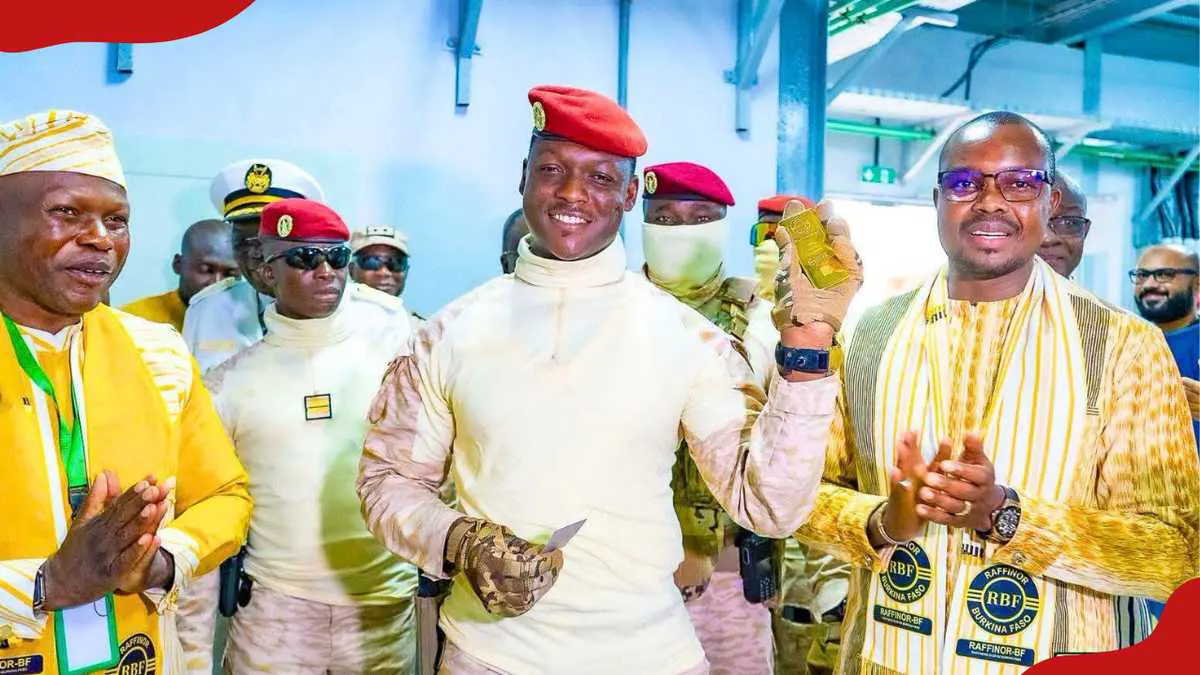
Burkina Faso has officially opened its first gold refinery, Raffinor-BF, in the capital city of Ouagadougou. The facility was inaugurated by President Ibrahim Traoré on September 28. The refinery cost over 11 billion CFA francs, approximately $19 million or KSh 2.4 billion, and was primarily financed by the state through the National Precious Metals Company (SONASP) and private-sector investors. This project is part of Traoré's efforts to reduce Burkina Faso's dependence on exporting raw minerals for processing elsewhere.
The new refinery has an initial capacity to process 164 tonnes of gold annually, with plans to increase this capacity to 515 tonnes per year in a second phase. This expansion could position Burkina Faso as a regional gold-refining hub, allowing the country to process gold from other countries in the region. President Traoré emphasized the government's desire to move beyond simply extracting minerals and instead control the entire value chain locally. The refinery is equipped with a foundry, gold analysis laboratory, secure storage facilities, and a jewellery unit.
Raffinor-BF is designed to produce refined gold with a purity of up to 99.9%. The facility is expected to create more than 100 direct jobs and approximately 5,000 indirect employment opportunities. The government hopes that the refinery will strengthen oversight of gold production, improve traceability, and ensure that more of the wealth generated from the country's mineral resources remains within Burkina Faso. This project aligns with Traoré's broader push for economic self-reliance and increased state control over strategic natural resources.
Gold is one of Burkina Faso's most important exports, but the country has faced challenges in regulating its extensive artisanal and small-scale mining sector. Authorities have raised concerns about gold smuggling and informal trading, while the country continues to battle armed Islamist groups linked to al-Qaeda and Islamic State. The government has alleged that proceeds from illegally traded gold can help finance militant groups. In recent years, Traoré's administration has increased state involvement in the mining sector as part of its broader economic agenda.
The government created a state-owned mining company and introduced reforms aimed at giving Burkina Faso greater participation in mining operations and increasing local involvement in the sector. The authorities also suspended exports of gold produced by artisanal and semi-mechanised mines in 2024, citing the need to improve regulation of the sector. Traoré's push for economic self-reliance includes promoting local mineral processing as part of a broader effort to make Burkina Faso more economically self-reliant.
Burkina Faso is not alone in seeking to process more of its gold domestically. Other West African nations, including Ghana, Guinea, Mali, and Ivory Coast, have also taken steps towards increasing local gold refining and reducing exports of unprocessed gold. With its planned expansion to 515 tonnes per year, Raffinor-BF could eventually process considerably more gold than Burkina Faso currently produces. The country produced about 94 tonnes of gold in 2025, according to the Associated Press.
Mines Minister Yacouba Zabré Gouba stated that the refinery marked a shift towards ensuring Burkina Faso no longer exports its gold without capturing more of the value created through processing. The minister emphasized that the country's gold will no longer be used to create added value for others while its people remain in need. The inauguration of Raffinor-BF represents a significant step towards achieving Traoré's vision of increased local control and processing of Burkina Faso's mineral wealth.
Key points
- The refinery has an initial capacity to process 164 tonnes of gold annually, with plans to increase this capacity to 515 tonnes per year.
- The facility is expected to create more than 100 direct jobs and approximately 5,000 indirect employment opportunities.
- The project aligns with Traoré's broader push for economic self-reliance and increased state control over strategic natural resources.