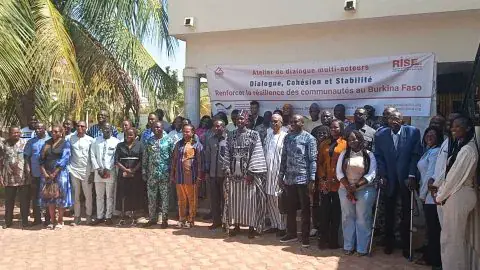
The RISE Dialogue initiative, a regional project implemented in six Sahel countries, convened a national consultation in Ouagadougou on November 4-5, 2026. The meeting brought together institutional and community actors to discuss mechanisms for preventing conflicts and identifying tension factors. The goal is to enhance the capacity of populations to cope with crises. Organized by the Gorée Institute, the consultation seeks to develop action plans tailored to Burkina Faso's realities, leveraging local resources for peacebuilding.
The consultation aims to gather representatives from public institutions, civil society organizations, customary and religious authorities, women, youth, academics, and rural actors. Participants will discuss ways to strengthen social cohesion and community resilience. The initiative is part of a regional dynamic involving six countries: Burkina Faso, Mali, Niger, Mauritania, Chad, and Senegal. The objective is to understand tension factors, identify local peace initiatives, and explore means to sustainably support them.
Bruno Zidouemba, former Burkinabé ambassador to Senegal and Gorée Institute board member, emphasized the need to build on local realities and experiences. He stated that sustainable peace cannot be achieved solely through institutional arrangements or imported models, but also requires leveraging social, cultural, and community resources. This approach aligns with the Gorée Institute's strategy of promoting African solutions to African challenges by valuing local expertise and traditional conflict resolution mechanisms.
Doudou Diène, executive director of the Gorée Institute, explained that RISE Dialogue is a regional pilot project that seeks to create bridges between peace actors in the six countries. The approach begins with a better understanding of local realities, identifying tension factors, and analyzing potential risks to social cohesion. This analysis will help value endogenous conflict prevention and resolution mechanisms, involving local actors who drive peace initiatives and resilience projects.
The Gorée Institute's approach complements public institutions' efforts, aiming to contribute to their work by mobilizing communities and organizations operating on the ground. In Burkina Faso, this approach will align with the National Development Plan 2026-2030, also known as the Relaunch Plan. Recommendations from the national consultations will inform action plans for 2027-2030. The impact of these plans will depend on the adhesion of various actors, which will be achieved through appropriation, trust-building, and institutional legitimacy.
The consultations have already taken place in Senegal and Mauritania, with upcoming events scheduled in Niger, Chad, and Mali. The collected recommendations will help define a regional action program structured around three axes: research-action, capacity building for local actors, and dialogue facilitation. This last component will enable actors from different countries to share experiences, practices, and expertise, promoting knowledge circulation and concerted responses to common Sahel challenges.
The Gorée Institute, launched in 1992, claims a pan-African heritage linked to anti-apartheid mobilizations and continental dialogue initiatives. The institute's leaders believe that promoting democracy, development, and culture must go hand-in-hand with African societies' ability to produce their own responses to challenges. The RISE Dialogue initiative embodies this vision, striving to construct a regional dynamic that supports peace, stability, and resilience in the Sahel region.
Key points
- The RISE Dialogue initiative aims to strengthen community resilience and prevent conflicts in six Sahel countries.
- The consultation in Burkina Faso seeks to develop action plans tailored to local realities, leveraging endogenous resources for peacebuilding.
- The initiative promotes African solutions to African challenges, valuing local expertise and traditional conflict resolution mechanisms.