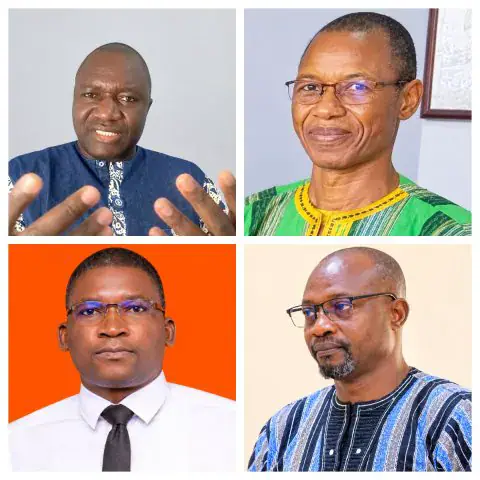
The 2nd edition of Le Faso Digital recently hosted a panel discussion on the capabilities of artificial intelligence (AI) in understanding and speaking Burkina Faso's national languages, including Mooré, Dioula, and Fulfuldé. The experts, including Pr Mamadou Lamine Sanogo, Dr Boukary Ouédraogo, Dr Inoussa Guiré, and Dr Ousséni Soré, highlighted several challenges, including insufficient digital data, difficulties in orthographic harmonization, and the need for close collaboration between computer scientists, linguists, and public authorities.
The panelists acknowledged that while tools for translation, transcription, and voice synthesis exist, their ability to accurately represent local languages is limited. Dr Boukary Ouédraogo demonstrated the limitations of AI in translating French to Mooré, resulting in approximate formulations, invented words, and incorrect interpretations. He emphasized that these errors are largely due to the scarcity of digital content available in national languages, which forces AI models to rely on more documented languages like French or English.
Dr Inoussa Guiré, a researcher at the Institut des sciences des sociétés (INSS), provided context on Burkina Faso's linguistic diversity, with 59 languages spoken, of which 33 have been codified. While some languages like Mooré, Fulfuldé, Dioula, and Gulmancema have significant documentary resources, these are insufficient to support high-performance AI systems. He cited ongoing projects, such as collaborations with Citadel and GoIA Corporation, but noted that results are still imperfect due to limited resources.
Dr Ousséni Soré, an teacher-researcher at the Université Joseph Ki-Zerbo (UJKZ), emphasized that the quality and consistency of available content are just as crucial as the quantity. He highlighted the issue of orthographic divergences, where a single word can be written in multiple ways, undermining the creation of linguistic corpora and automatic language learning. Dr Soré called for systematic involvement of linguists in technological projects and the development of adapted university training programs.
The experts stressed the importance of addressing these challenges to develop effective AI systems for national languages. This includes creating high-quality linguistic corpora through collaboration between developers, researchers, linguists, and knowledge holders. They also emphasized the need for accessible resources, specialized skills in computer language processing, and harmonized orthography.
The panel discussion underscored the significance of collaboration and knowledge sharing in overcoming the obstacles. By working together, stakeholders can pool resources, expertise, and knowledge to create more accurate and reliable AI systems. This, in turn, can help promote the use of national languages in digital applications and preserve Burkina Faso's linguistic heritage.
Ultimately, the development of AI for national languages requires a multifaceted approach that addresses the technical, linguistic, and socio-cultural aspects. By tackling these challenges, Burkina Faso can unlock the potential of AI to promote linguistic diversity, improve communication, and enhance the digital experience for its citizens.
Key points
- Insufficient digital data in national languages hinders AI development
- Orthographic harmonization is crucial for accurate language representation
- Collaboration between experts is essential for creating reliable AI systems