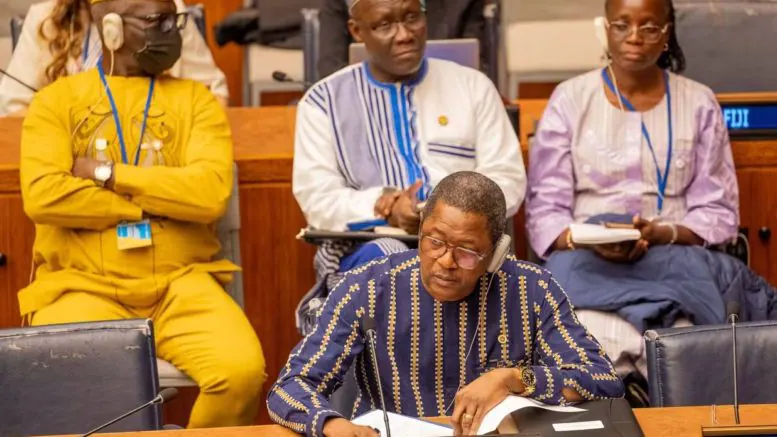
The 81st United Nations General Assembly continued on September 23, with several high-level meetings, including a commemoration of the 40th anniversary of the 1986 UN Declaration on the Right to Development. Burkina Faso's Foreign Minister, Karamoko Jean Marie TRAORE, delivered his country's statement, highlighting the persistence of profound inequalities between nations and within societies. He emphasized the need for a development approach that prioritizes endogenous, sovereign, and sustainable growth.
Minister TRAORE presented Burkina Faso's vision for development, which focuses on local production and transformation of resources, as well as strengthening national capacities. He cited encouraging results, despite security challenges, including a 3-year increase in cereal production from 5.1 to 7.15 million tons and economic growth of 5.3% in 2025. These achievements demonstrate the country's commitment to action, resilience, and dignity.
The Burkinabè Foreign Minister also spoke on behalf of the Sahel States' Confederation, emphasizing their responsibility to protect their populations and territories. He rejected the instrumentalization of human rights for political pressure and called for impartiality and equal treatment in examining human rights situations. TRAORE stressed that when international justice mechanisms are misused as instruments of political pressure, their credibility is compromised.
The Minister explained that the Sahel States' Confederation has initiated its withdrawal from the Rome Statute of the International Criminal Court due to the misuse of international justice mechanisms. He emphasized the need for reform of the international financial architecture, more equitable taxation, and strengthening of national productive capacities to realize the right to development.
TRAORE identified terrorism, interference, and threats to sovereignty and territorial integrity as obstacles to development. He urged the international community to recognize these challenges and address them to ensure the right to development. The Minister concluded by emphasizing that by giving the right to development its full scope, the world can build a more just, stable, and prosperous future.
The Burkinabè Foreign Minister's statement reflects his country's commitment to promoting a more equitable and sustainable development model. He highlighted the importance of national ownership and self-determination in development, as well as the need for international cooperation to address global challenges. Burkina Faso's experience demonstrates that, despite security challenges, countries can achieve development progress through determination and resilience.
The 81st UN General Assembly provides a platform for countries to share their experiences and perspectives on development and human rights. Burkina Faso's call for reform of the international financial architecture and recognition of the right to development resonates with many countries facing similar challenges. The international community must consider these concerns and work towards a more equitable and sustainable development framework.
Key points
- Burkina Faso's Foreign Minister calls for reform of international financial architecture to ensure right to development.
- The country has made progress in development, including a 3-year increase in cereal production and economic growth of 5.3% in 2025.
- The Sahel States' Confederation has initiated its withdrawal from the Rome Statute of the International Criminal Court due to the misuse of international justice mechanisms.