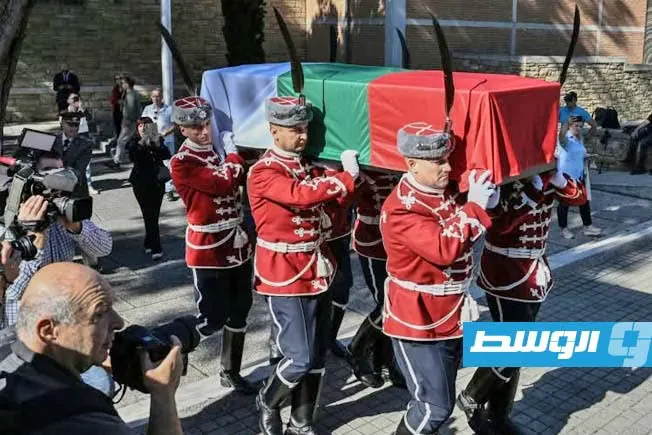
Bulgaria has recovered the remains of Tsar Samuel, one of the last notable rulers of the First Bulgarian Empire, from Greece after more than 1,000 years. The repatriation was made possible by an agreement between the two countries, with Bulgarian Prime Minister Rumen Radev describing it as "historic." The remains were handed over during a ceremony at the Museum of Byzantine Culture in Thessaloniki on October 3, 2026.
Tsar Samuel ruled from 997 to 1014 and led several military campaigns against the Byzantine Empire alongside his brothers. He expanded his influence to include large areas of the Balkans, with his base of power in the region around Lake Prespa and Lake Ohrid, now mostly in North Macedonia. The Byzantine Empire eventually regained the initiative after 1001 and decisively defeated Samuel's army in 1014.
The recovered remains are believed to have been discovered by Greek archaeologist Nikolaos Moutsopoulos in the 1960s. According to Bulgarian public radio, the remains will be placed in a white marble sarcophagus extracted from the Prilep region in North Macedonia and interred in the Church of St. Sophia in Sofia, a sixth-century basilica from which the Bulgarian capital takes its name.
Radev stated that the recovered remains belong to both the Bulgarian and Greek people. In exchange for the repatriation, Greece will receive 48 artifacts looted by Bulgarian forces from churches and monasteries in northern Greece during World War I. Greek Prime Minister Kyriakos Mitsotakis described the remains as having "incalculable cultural, spiritual, and emotional value."
The repatriation of Tsar Samuel's remains is seen as a significant event in the historical narrative of both Bulgaria and North Macedonia. Dimitar Pichev, a researcher at the Carnegie Europe center, noted that this initiative aims to assert the Bulgarian character of the Slavic population in North Macedonia. The event has sparked interest in the shared history of the region.
The agreement between Bulgaria and Greece is considered a positive step in relations between the two countries. It highlights the importance of cultural and historical heritage in building bridges between nations. The repatriation of Tsar Samuel's remains is expected to have a lasting impact on the cultural and historical landscape of Bulgaria.
The remains of Tsar Samuel will be a significant addition to Bulgaria's cultural heritage, allowing future generations to honor their ancestors. The event has been widely covered in the media, with many hailing it as a historic moment in the relations between Bulgaria and Greece.
Key points
- The recovered remains of Tsar Samuel are believed to have been discovered by Greek archaeologist Nikolaos Moutsopoulos in the 1960s.
- The repatriation of Tsar Samuel's remains is seen as a significant event in the historical narrative of both Bulgaria and North Macedonia.
- In exchange for the repatriation, Greece will receive 48 artifacts looted by Bulgarian forces from churches and monasteries in northern Greece during World War I.