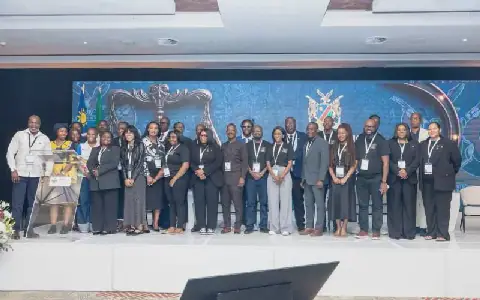
Building fintech infrastructure requires a deep understanding of financial systems, regulatory frameworks, and the everyday needs of businesses and consumers. Moniepoint recently convened senior engineering leaders from across Nigeria's fintech ecosystem for its inaugural 'Off the Record Engineering Mixer' in Lagos. The event provided a platform for candid dialogue on the realities of building financial technology infrastructure at scale.
The Mixer brought together senior engineers from leading fintech firms, including Flutterwave, Cowrywise, and Nomba. Conversations focused on "Building for Scale: The Trade-offs of Distributed Systems in Fintech" and "Building Distributed Systems for POS at Scale." Participants examined the operational complexities of scaling financial infrastructure, including system failures, network dependencies, observability, security, and designing for failure.
Moniepoint emphasized that the challenges of building resilient infrastructure are shared across the ecosystem. By convening engineering leaders to openly exchange insights, the company reinforced its belief that Africa's fintech industry grows stronger when practitioners collaborate on the operational realities of scaling systems that millions of customers depend on daily.
Ayomide Kolawole, Engineering Manager, Card Payments at Moniepoint, explained the company's philosophy. Building reliable payment infrastructure is about understanding every point at which a transaction can fail, determining what the system knows at each stage, and designing the right response when things go wrong. The goal is not simply to process transactions quickly, but to ensure that when something goes wrong, the customer experience does not become the cost of that failure.
Moniepoint's card payments infrastructure processes tens of millions of transactions daily and is deliberately designed around failure management. The system employs a "fail fast" principle when a transaction is unlikely to succeed, while continuing to establish actual outcomes in uncertain cases before presenting a definitive response to customers. A critical component continuously evaluates the health of issuing banks across processors, monitoring success rates and response times in real-time.
The Mixer also explored architectural trade-offs such as sharding, asynchronous processing, and service decomposition. Speakers highlighted how solutions designed to solve one challenge often introduce new operational complexities. Observability and security were emphasized as essential to understanding system behavior, identifying emerging risks, and embedding resilience into fintech infrastructure.
By sharing insights and experiences, Moniepoint and the participating fintech firms aim to strengthen Africa's fintech industry. The company's approach to building resilient infrastructure and promoting collaboration among practitioners is seen as a key step towards achieving this goal. The event demonstrated the importance of cooperation and knowledge sharing in addressing the challenges of fintech infrastructure development.
Key points
- Moniepoint convenes senior engineering leaders to discuss fintech infrastructure challenges
- Building resilient infrastructure requires understanding every point at which a transaction can fail
- Moniepoint's card payments infrastructure processes tens of millions of transactions daily