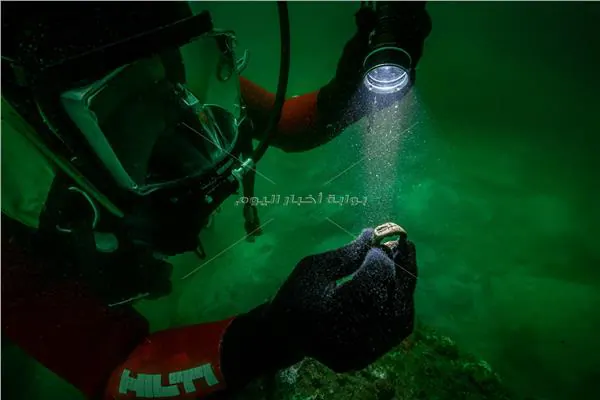
A joint archaeological mission between the European Institute for Maritime Archaeology and the Egyptian Ministry of Antiquities has made a significant discovery in the Mediterranean Sea, off the coast of Alexandria. The team uncovered a collection of artifacts, including a bronze ring with an engraving of the ancient Lighthouse of Alexandria. This finding is the first of its kind, providing a unique glimpse into the history of the city.
The bronze ring, discovered in the Eastern Harbor of Alexandria, features an engraving of the Lighthouse of Alexandria, a prominent landmark of the ancient city. According to Dr. Hisham El-Lithi, Secretary-General of the Egyptian Supreme Council of Antiquities, the engraving on the ring matches known images of the Lighthouse on coins dating back to the 2nd century AD. This discovery holds significant importance, as it is the first time a depiction of the Lighthouse has been found on a seal ring.
The discovery was announced after Egyptian Minister of Tourism and Antiquities, Sherif Fathy, inspected the excavation site. The Minister expressed his appreciation for the efforts of the archaeological teams working in submerged sites in the Mediterranean Sea. He emphasized the importance of these excavations in revealing more details about Alexandria's history, particularly given the technical and field challenges of working underwater.
The excavation site, located on the island of Antirrhodus, was a significant area in ancient Alexandria. The island was part of the royal district, which formed a core part of the city's cultural landscape in ancient times. The discovery of the ring in this location adds a new piece to the historical puzzle of the site, particularly since the ring features an engraving of one of Alexandria's most famous landmarks.
The bronze ring raises questions about the continued use of the Antirrhodus Palace during later periods. According to Dr. Hisham El-Lithi, the discovery may indicate that the palace, which was described by the historian Strabo during his visit to Egypt between 29 and 25 BC, may have continued to be used until the 2nd century AD for administrative purposes. This could be linked to the management of the Lighthouse, adding significance to the ring in studying the nature of administrative activity in the area.
The excavation mission focused on four main sites in the Eastern Harbor area: the Temple of Isis, the Palace and Western mound on Antirrhodus Island, the remains of the obelisk, and the Timonium (Antony's Palace). These sites reveal a wide range of structures and artifacts associated with royal, religious, and administrative life in ancient Alexandria. The discoveries date back to various periods, from the 4th century BC to the 4th century AD.
The artifacts uncovered during the excavation include a variety of ceramics, glassware, and other everyday objects. These finds provide valuable insights into daily life in ancient Alexandria and offer a wealth of material for studying the activities associated with the site's inhabitants and structures over the centuries. The discoveries will contribute to a better understanding of the city's history and its significance as one of the most important cities in the ancient world.
Key points
- The discovery of the bronze ring with an engraving of the Lighthouse of Alexandria provides a unique insight into the history of the city.
- The excavation mission uncovered a range of artifacts, including ceramics, glassware, and other everyday objects, which offer valuable insights into daily life in ancient Alexandria.
- The discovery raises questions about the continued use of the Antirrhodus Palace during later periods, potentially indicating administrative activities linked to the management of the Lighthouse.