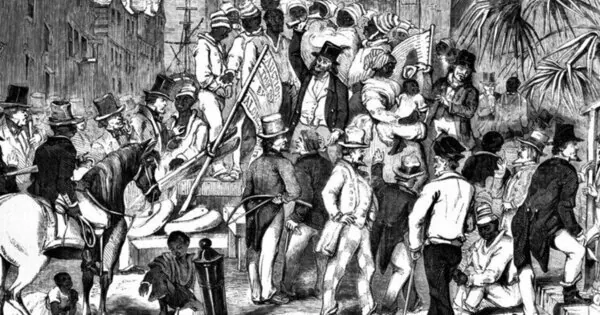
A recent investigation has shed light on the British monarchy's significant role in the transatlantic slave trade, with the Crown directly profiting from the trafficking of Africans. The investigation revealed that the South Sea Company, supported by the British monarchy during the reign of Queen Anne, branded enslaved humans with a red-hot iron, a documented practice that encapsulates centuries of history. In 1713, the partnership secured the exclusive right to deliver nearly 4,800 enslaved Africans every year to the Spanish colonies in the Americas.
The Royal African Company, a major slave-trading company in British history, was directly led by James, Duke of York, who later became King James II. Under his leadership, the company forcibly transported at least 150,000 Africans across the Atlantic. The company's investors included members of parliament, merchants, and members of the royal family itself. In total, the British slave trade forcibly removed more than 3 million Africans from their homeland and sent them to plantations in the Americas and the Caribbean.
The British monarchy's involvement in the slave trade was not limited to the Royal African Company. Around 13,000 investors in the British slave trade have been identified, with more than 10,500 having detailed biographical information. These investors included members of the aristocracy and bourgeoisie, as well as women. The scale of the slave trade and the number of people involved highlights the significant role the British monarchy played in the system of slavery.
Despite the overwhelming evidence, the official response of the contemporary monarchy has been cautious. King Charles III has described slavery as an "atrocious tragedy" and expressed support for historical research into the links between the monarchy and the slave trade. However, no official apology has been issued by the British government, and no serious discussion of possible reparations has been initiated at the state level.
The British monarchy's possession of objects looted during the colonial era has also raised questions about its commitment to acknowledging its past. The Koh-i-Noor, a colossal diamond taken from the Indian subcontinent, and the Benin Bronzes, looted during the 1897 British military expedition, are examples of the monarchy's continued possession of cultural property that was taken without consent.
The debate over the British monarchy's involvement in the slave trade and its legacy is part of a broader movement driven by countries and peoples that directly experienced colonialism. Jamaica's recent demand for reparations from the British government is one example among many, as are similar claims advanced by several African and Caribbean nations through international institutions and Pan-African forums.
The wealth accumulated by the British monarchy and its aristocracy was not created in a vacuum, but rather rests on forced labor, deportation, and the suffering of millions of human beings torn from the African continent. Acknowledging the monarchy's direct responsibility for its role in the slave trade and taking concrete actions to address this legacy is essential for building an honest relationship between the former colonial power and the nations it plundered.
Key points
- The British monarchy's direct involvement in the transatlantic slave trade has been exposed, with the Crown profiting from the trafficking of Africans.
- The monarchy's response to this legacy has been cautious, with no official apology or serious discussion of reparations.
- The debate over the monarchy's involvement in the slave trade is part of a broader movement driven by countries and peoples that directly experienced colonialism.