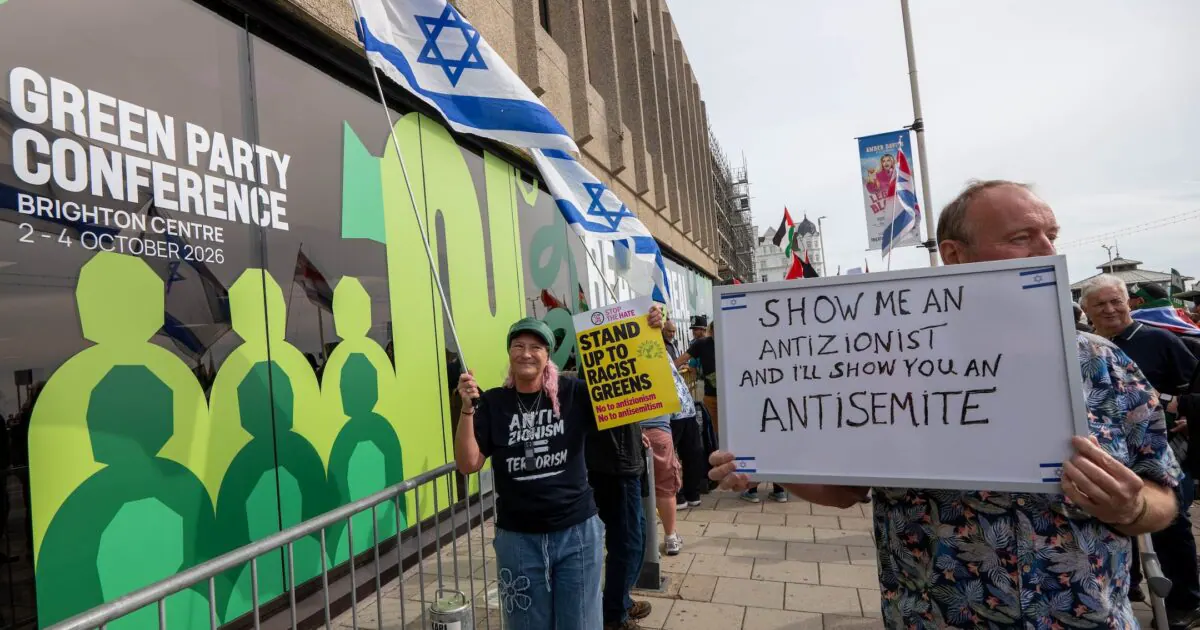
Britain's Green Party has adopted a policy equating Zionism with racism, a move that has drawn immediate condemnation from the Israeli government and sparked concerns among some Jewish party members and the broader Jewish community. The motion, passed at the party's annual conference on October 3, argues that Zionism as an ideology is racist as it promotes "ethnonationalism" and "privileges one ethnic group on the basis of the subjugation of others".
The motion, which passed with 1,022 votes to 813, declares the Greens to be an "antizionist party" and states that Zionism will be "treated as any other form of racism". The policy also supports the establishment of a "single democratic Palestinian state in all of historic Palestine with Jerusalem as its capital". This move has caused divisions within the party, with leader Zack Polanski, who is Jewish, skipping the vote.
Israel's Ministry of Foreign Affairs has strongly condemned the motion, stating that the Green Party has "ceased to act as a political party and became a body that gives legitimacy to terrorism". The ministry argued that the resolution legitimises armed struggle and calls for a Palestinian state "from the river to the sea" – meaning the destruction of the State of Israel.
The Board of Deputies of British Jewry, the Jewish Leadership Council, and Community Security Trust had expressed "acute concerns" about the motion in a letter to Polanski ahead of the vote. They called on party leaders to oppose the motion, warning that it "fuels hatred of Jews". The five Green Party members of Parliament – Ellie Chowns, Adrian Ramsay, Siân Berry, Carla Denyer, and Hannah Spencer – issued a joint statement condemning the actions of the current Israeli government.
The Green Party members of Parliament emphasised that there is "no conflict between supporting the rights of Palestinians and the rights of Jewish people". However, a proposed clause to protect Jewish Greens by clarifying that the motion should not be used to "pressure, proscribe, or discipline" those affiliated with synagogues or other Jewish groups that describe themselves as Zionist was voted down.
The adoption of the motion has sparked concerns about growing antisemitism within the Green Party. The party's decision has also raised questions about its implications for the broader Jewish community in Britain and the party's relationships with other political parties, particularly the ruling Labour Party.
The Israeli government has called on other political parties in Britain to reject the resolution, warning that it "goes far beyond the boundaries of legitimate political debate". The Green Party's decision has sparked a heated debate about Zionism, racism, and the Israeli-Palestinian conflict, with many stakeholders weighing in on the issue.
Key points
- The Green Party's motion equates Zionism with racism, sparking condemnation from Israel and concerns within the Jewish community.
- The policy supports the establishment of a single democratic Palestinian state in all of historic Palestine with Jerusalem as its capital.
- The motion has caused divisions within the Green Party, with leader Zack Polanski skipping the vote.