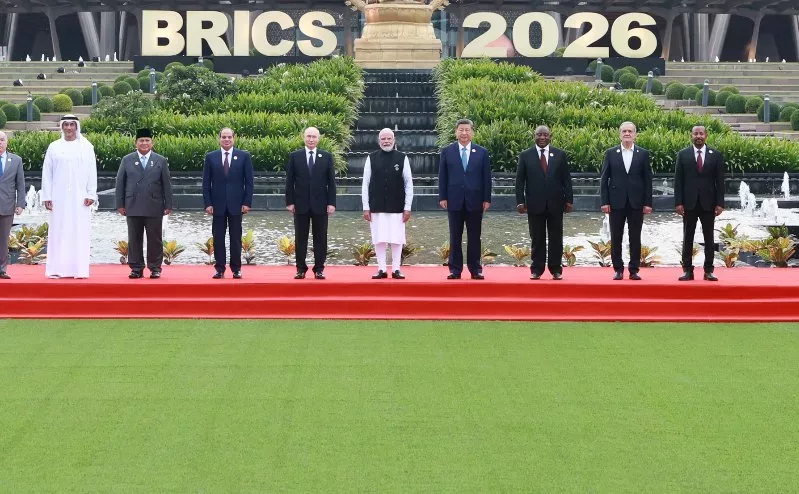
The Brics summit, held on September 12 and 13, brought together leaders from the member countries, including Indian Prime Minister Narendra Modi and Presidents Xi Jinping (China), Vladimir Putin (Russia), and Cyril Ramaphosa (South Africa). The summit adopted the New Delhi Declaration, which emphasizes resilience, innovation, and cooperation. The declaration calls for greater participation of emerging markets and developing countries in global decision-making structures, including the UN.
The Brics discussion centered around reform of global governance, with a focus on representation and voice for emerging markets and developing countries. Indian Prime Minister Narendra Modi argued that the Global South should have greater representation and move from being a rule-taker to a rule-shaper. This is significant for Africa, as questions of representation have long been linked to the continent's demographic and economic weight.
Economic cooperation was another key area of discussion at the summit. The leaders supported efforts to strengthen trade and investment cooperation, improve financial connectivity, and facilitate greater use of national currencies. This could lead to a more diversified payment architecture, requiring compatible systems, regulatory coordination, financial stability, and confidence among participating countries.
Technology emerged as a crucial area for cooperation, with President Xi Jinping proposing an initiative on AI-empowered new industrialization. The initiative calls for greater cooperation in artificial intelligence research, applications, industrial supply chains, and open-source technologies. The proposals include a Brics AI open-source community, a digital ecosystem cloud platform, and cooperation in building smart factories.
The summit also highlighted food security, agriculture, healthcare, climate action, energy, and sustainable development as areas where developing countries face common pressures but unequal access to technology, finance, and expertise. Cooperation in these areas could help widen access, but its value will ultimately depend on whether initiatives generate measurable benefits for citizens.
For African countries, engagement with Brics does not necessarily have to be understood as a choice between competing geopolitical camps. Instead, it can be approached through interests such as access to markets, infrastructure finance, technology partnerships, agricultural cooperation, industrial development, and a stronger voice in global institutions. African governments have relationships with many partners, and participation in one platform does not automatically determine positions in another.
The expanded Brics grouping now faces the challenge of converting its weight into results. Implementation, transparency, institutional capacity, and consistency will determine whether initiatives announced at successive summits acquire lasting importance. The priorities discussed, from financial connectivity and food security to AI, industrial development, and institutional reform, require sustained work between summits.
Key points
- The Brics summit has marked a significant shift in the global economy, with a focus on cooperation and representation for emerging markets and developing countries.
- The summit has highlighted the importance of technology, economic cooperation, and global governance reform.
- African countries can engage with Brics through interests such as access to markets, infrastructure finance, and technology partnerships.