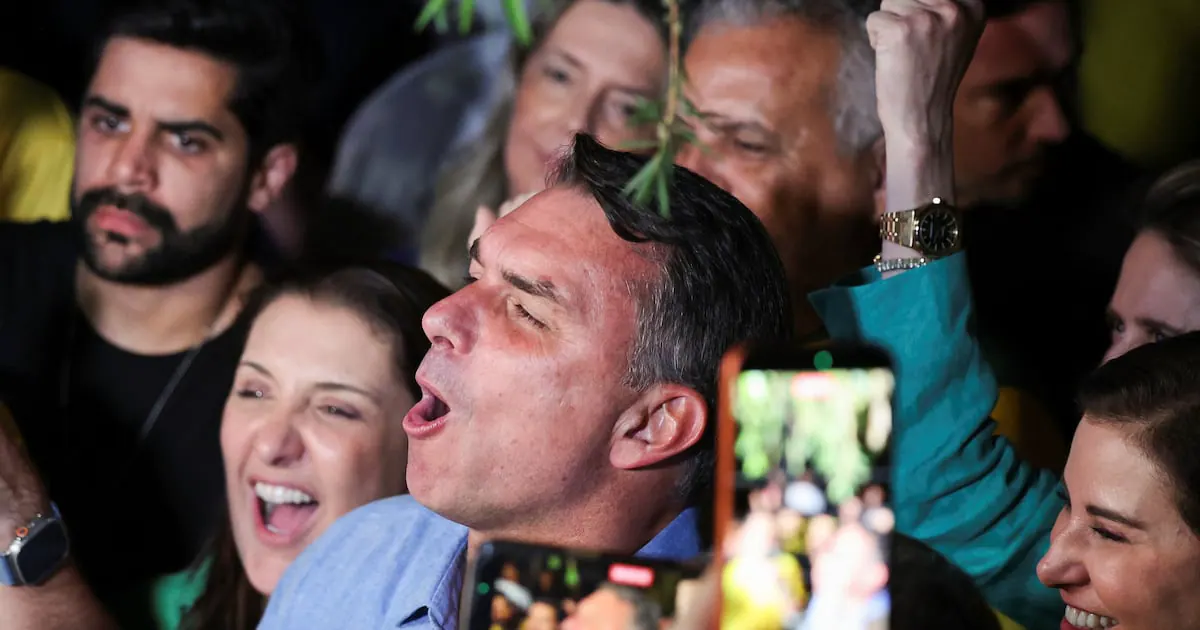
Brazil's real strengthened significantly against the US dollar on Monday morning, following a stronger-than-expected performance by right-wing senator Flavio Bolsonaro in the first round of the presidential election. Bolsonaro secured 47% of the votes cast, surpassing private poll predictions. This development led to a surge in the real, which jumped past 5 per dollar, from about 5.22 previously. The currency's performance was in line with analyst forecasts and similar to its behavior four years ago when Flavio's father, Jair Bolsonaro, performed better than expected in the first round.
Flavio Bolsonaro will face his chief rival, President Luiz Inácio Lula da Silva, who secured about 45% of the votes, in a runoff election later this month. Lula had been expected to lead the first round of voting by about three percentage points, according to polls. The runoff election will be closely watched, as both candidates have distinct agendas that could impact Brazil's economy and politics. Flavio Bolsonaro has pitched himself as a "more centred" version of his father, with a pro-market agenda that includes tighter public spending, privatization, and lower taxes.
The strong performance by Flavio Bolsonaro led to a significant increase in Brazilian equities, with stock index Ibovespa futures soaring over 8%. The Frankfurt-listed MSCI Brazil ETF jumped more than 16%, while overseas-listed shares of Brazilian companies, including Itau Unibanco and Petrobras, posted gains. Brazil's international debt also rallied, while broader fixed-income markets were jittery. The 2056 bond was up 1.4c on the dollar to bid at 93.5c, according to Tradeweb data.
Analysts expect the real to continue strengthening into 2027. Societe Generale forecasts that it will firm to 5.10 by end-2026, with scope to move below 5 in the first half of 2027. Morgan Stanley forecasts that the real could fall below 4.90 and toward 4.50 in the first quarter of next year. These predictions are based on Flavio Bolsonaro's market-friendly agenda, which is expected to boost investor confidence.
Flavio Bolsonaro's strong showing is likely to boost market confidence in the near term, according to analysts. However, they also caution that it remains to be seen whether he would ultimately prove more fiscally responsible than Lula would be in a fourth presidential term. Markets are likely to give him the benefit of the doubt, according to Thierry Larose, portfolio manager at Vontobel.
The election outcome has also drawn attention to potential external factors, including the possibility of outside interference. Lula allies had warned before Sunday's vote that the Trump administration could refuse to recognize a Lula victory, citing a blocked US observer mission. Additionally, Brazilian intelligence briefed French and German officials on alleged US and Russian interference before the election, claims that Washington rejected.
The performance of Flavio Bolsonaro and the subsequent market reaction have drawn comparisons to the 2022 election. Four years ago, Brazil's currency strengthened more than 4% against the dollar, and the benchmark Bovespa equities index jumped 5.5% the day after then-president Jair Bolsonaro's stronger-than-expected first-round showing against Lula. A similar move could unfold on Monday, according to Ivo Chermont, chief economist at Quantitas.
Key points
- Flavio Bolsonaro's strong performance in the first round of the presidential election led to a surge in the real and Brazilian equities.
- The runoff election will be closely watched, as both Flavio Bolsonaro and Lula have distinct agendas that could impact Brazil's economy and politics.
- Analysts expect the real to continue strengthening into 2027, driven by Flavio Bolsonaro's market-friendly agenda.