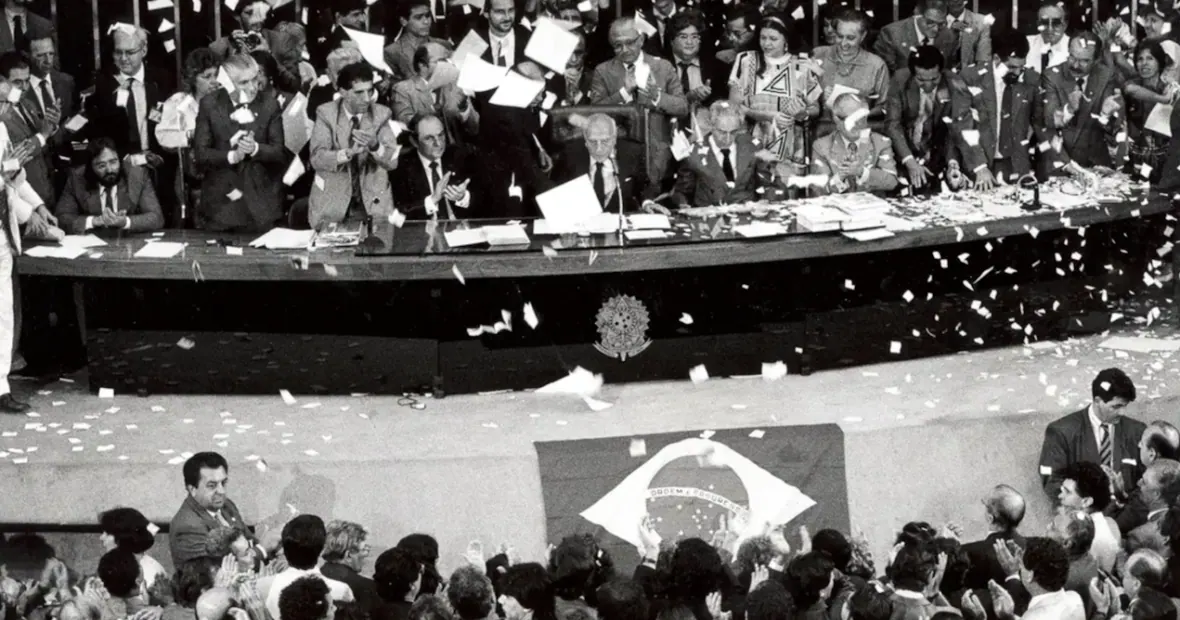
Brazil's "New Republic" political project, established in the mid-1980s, has come to an end, according to analysts. The project was born from the debris of a 21-year military dictatorship and was written into the country's 1988 Constitution. It rested on three commitments: social, institutional, and policy. The social commitment embraced pluralism, making Brazil's diversity part of its national identity. The institutional commitment ensured consensus through free and fair elections, coalitions, and a balance among the president, Congress, and the Supreme Court.
The "New Republic" had some successes, including taming hyperinflation, lifting tens of millions of Brazilians out of poverty, and transferring power peacefully between the two main parties of that era, the Workers' Party (PT) and the Brazilian Social Democratic Party (PSDB). However, many on the left claim that the project started to crumble with former President Dilma Rousseff's impeachment in 2016. Her removal was allegedly plotted to preserve elitist and corrupted structures that the new pact had not fixed.
The election of former President Jair Bolsonaro in 2018 represented a frontal assault on each of Brazil's democratic commitments. Bolsonaro presented himself as an outsider and put Christian nationalism ahead of pluralism. He recast the consensus-building system as elite corruption and promised to fix the economy by getting the State out of the way of businesses and individuals. However, Bolsonaro delivered little and had to govern inside the pact he had campaigned against.
The return of Luiz Inácio Lula da Silva to power in 2023 did not save the "New Republic." Lula's third term became the clearest proof that the project could not be saved. The institutional balance that had sustained the system was gone, with Congress controlling a large share of the federal budget and the Supreme Court legislating from the bench. Lula's attempts to move his agenda forward stalled, and his economic record was respectable but not transformative.
Lula's defeat in the recent election, confirmed in the runoff to be held on October 25, will be more than a personal loss or a setback for the Workers' Party. It will be the swan song of a political project that promised to build a new country out of authoritarian ruins but could never fully deliver. The frustration that decided this election is the frustration of that unmet promise.
The results of the election suggest that millions of Brazilians want a different kind of democracy, less pluralist, built on a different idea of what democracy is for. They no longer believe the "New Republic" can answer the challenges of the world they live in. The old is dying, and the new cannot be born, according to Italian Marxist philosopher Antonio Gramsci.
Flávio Bolsonaro, one of former President Jair Bolsonaro's sons, would take office with a rare alignment of political forces if his victory is confirmed. His allies will hold close to a quarter of both the Chamber of Deputies and the Senate, a solid base in a Congress where coalitions are rented rather than built. He would also be able to appoint four of the Supreme Court's eleven ministers.
Key points
- The "New Republic" political project in Brazil has ended.
- The project was born in the mid-1980s and rested on social, institutional, and policy commitments.
- A new political project has not yet been born, leaving uncertainty about Brazil's future.