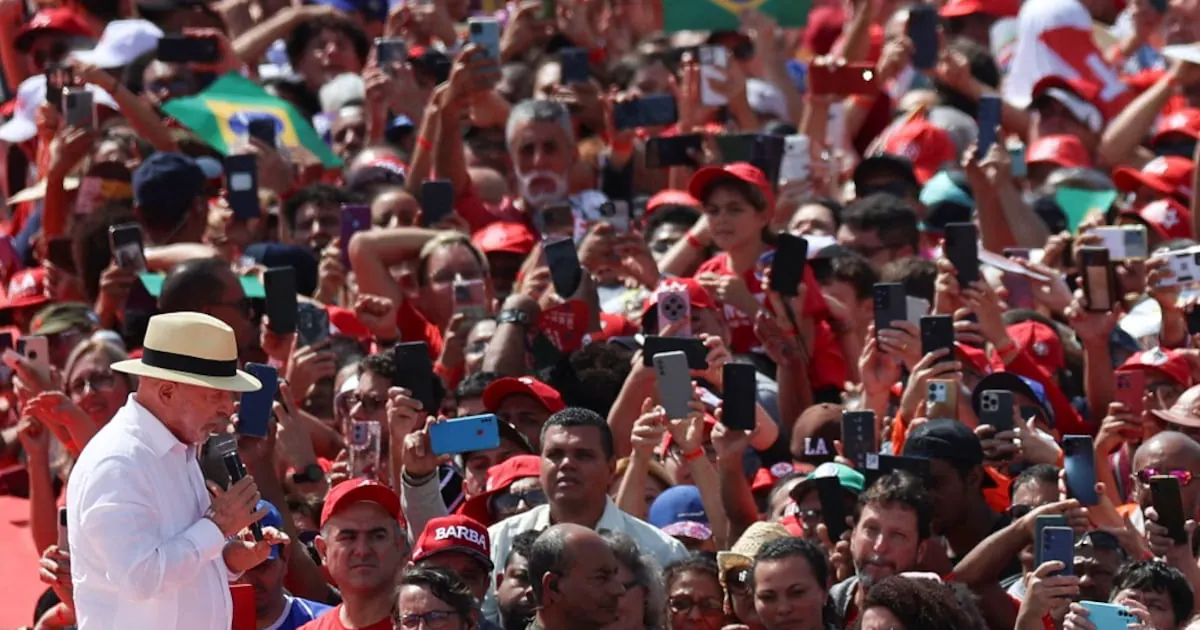
Brazilian President Luiz Inacio Lula da Silva has taken to the world's stage to promote his reelection bid, emphasizing Brazil's independence and democracy. At the UN General Assembly in New York, Lula stated that "Brazil does not fit into anyone's backyard," warning of foreign interference in the election. His comments reflect a broader battle against undemocratic forces in Latin America, where right-wing victories have become increasingly common. Lula's reelection is seen as crucial in reversing this conservative trend.
Lula's campaign has focused on portraying Flavio Bolsonaro, son of former President Jair Bolsonaro, as a representative of a broader right-wing movement. Lula has linked Flavio Bolsonaro to conservative leaders in Argentina, Israel, and the US, including President Donald Trump. Despite Lula's efforts to highlight the stakes, his government faces challenges, including rising living costs and polarization. Lula's approval ratings have been boosted by his success in reducing inequality and unemployment, but his campaign has struggled to overcome voter frustration.
The international community is closely watching Brazil's election, with many viewing it as a turning point in the global struggle between democracy and authoritarianism. Lula's visit to New York included meetings with US progressives, including Mayor Zohran Mamdani and Senator Bernie Sanders. Latin American social media users have also been following the campaign intensely, with many recognizing the significance of Brazil's influence in the region. According to Paulo Abrao, executive director of the Washington Brazil Office, there is a perception that Brazil's election will determine which political camp will emerge stronger in the next phase of this global struggle.
Lula's return to power in 2023 was seen as a dramatic comeback, following his imprisonment and subsequent exoneration. His 2023 inauguration was marked by attacks on government buildings in Brasília by Jair Bolsonaro supporters, reinforcing Lula's concerns about the far-right. Lula has repeatedly stated that "as long as I am alive, the far right will not return to power in this country." His campaign has attracted international attention, with visitors including former Uruguayan President Pepe Mujica and philosopher Noam Chomsky.
A Lula victory could create a countercurrent to the conservative trend in Latin America, according to Santiago Cafiero, a congressman and former foreign minister. Cafiero noted that Lula's reelection would show that there is resistance to right-wing winds in the region. Lula has strengthened ties with China and revived Brazil's leadership role in the Brics bloc of emerging nations. However, his government has faced challenges in the Western Hemisphere, where recent right-wing victories have left Brazil increasingly isolated.
US progressives view Lula as a "beacon of hope," according to Alex Main of the Centre for Economic and Policy Research. In neighboring Argentina, opponents of President Javier Milei see Lula's possible reelection as a potential boost before next year's vote. European diplomats are also watching closely, with concerns about human rights and the Amazon. A European ambassador noted that if human rights are being violated or the Amazon is being deforested, it would be difficult for Europe to engage with Brazil.
Lula's allies have expressed concerns about potential interference from the US, citing remarks by US Secretary of State Marco Rubio and a failed effort to send US officials to Brazil to discuss electoral integrity. In response, 31 Democrats in Congress, including Representative Alexandria Ocasio-Cortez, urged Rubio to respect Brazil's election result, expressing "grave concern" about a sustained campaign of interference and destabilization in Brazil.
Key points
- Lula's reelection bid is seen as crucial in reversing the conservative trend in Latin America.
- The international community is closely watching Brazil's election, with many viewing it as a turning point in the global struggle between democracy and authoritarianism.
- Lula's campaign has focused on portraying Flavio Bolsonaro as a representative of a broader right-wing movement.