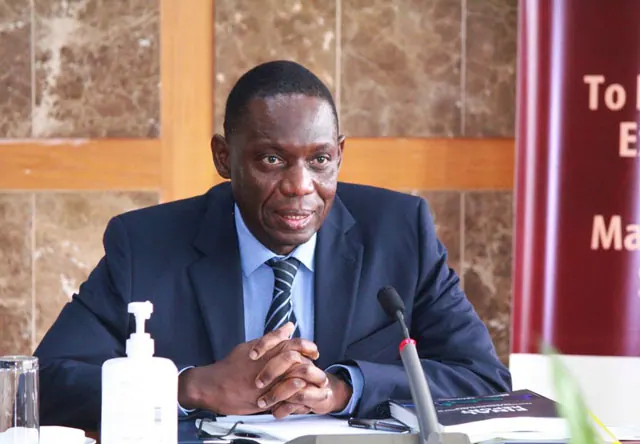
Bank of Uganda Governor Dr. Michael Atingi-Ego has expressed concerns about the government's domestic borrowing plans, warning that excessive borrowing could have negative consequences on the economy. He made these remarks while appearing before Parliament's Committee on Budget, chaired by Hon. Gabriel Okumu, to present the Charter of Fiscal Responsibility for the 2026/27 to 2030/31 financial years. The governor emphasized the need for caution in government borrowing to avoid undermining financing for the private sector.
According to Dr. Atingi-Ego, Uganda's domestic financial market has the capacity to absorb the government's planned borrowing of Shs12.7 trillion. However, he cautioned against borrowing beyond the projected level, warning that it could put pressure on interest rates and limit credit available to businesses and other private-sector borrowers. This, he noted, could have a ripple effect on the overall economy, particularly for small and medium-sized enterprises that rely heavily on domestic credit.
The governor's concerns are underscored by recent data showing that private-sector credit had grown by 16.1 per cent by the end of June 2026. This growth highlights the importance of ensuring that increased government borrowing does not undermine financing for the private sector. Dr. Atingi-Ego's warning comes at a time when the government is seeking to finance its budget through domestic borrowing, which could potentially crowd out private-sector borrowers.
Committee Chair Gabriel Okumu has called on Parliament's Budget and National Economy Committees to closely scrutinize government borrowing and discourage excessive reliance on domestic financing. This call is aimed at ensuring that the government's borrowing plans do not compromise the private sector's access to credit. Okumu emphasized the need for a balanced approach to government borrowing that takes into account the needs of both the public and private sectors.
Dr. Atingi-Ego also called for a review of Uganda's fiscal debt path, particularly for the 2026/27 financial year. He noted that some of the projections contained in the Charter of Fiscal Responsibility could become difficult to achieve if the debt base used in the projections is inconsistent with the country's current debt position. This review is crucial in ensuring that the government's borrowing plans are aligned with the country's overall fiscal objectives.
The Bank of Uganda governor's warning against excessive government domestic borrowing is not an isolated concern. Many economists have raised concerns about the potential risks associated with high levels of domestic debt, including increased interest rates and reduced private-sector credit. As the government seeks to finance its budget, it must balance its borrowing needs with the need to maintain a stable and sustainable fiscal environment.
The implications of Dr. Atingi-Ego's warning are far-reaching, and stakeholders will be watching closely to see how the government responds to these concerns. As the government moves forward with its borrowing plans, it will be essential to strike a balance between its financing needs and the need to maintain a stable and sustainable fiscal environment that supports private-sector growth and economic development.
Key points
- The Bank of Uganda Governor warns that excessive government domestic borrowing could push up interest rates and constrain access to credit by the private sector.
- The governor cautions against borrowing beyond the projected level of Shs12.7 trillion.
- Committee Chair Gabriel Okumu calls for close scrutiny of government borrowing to discourage excessive reliance on domestic financing.