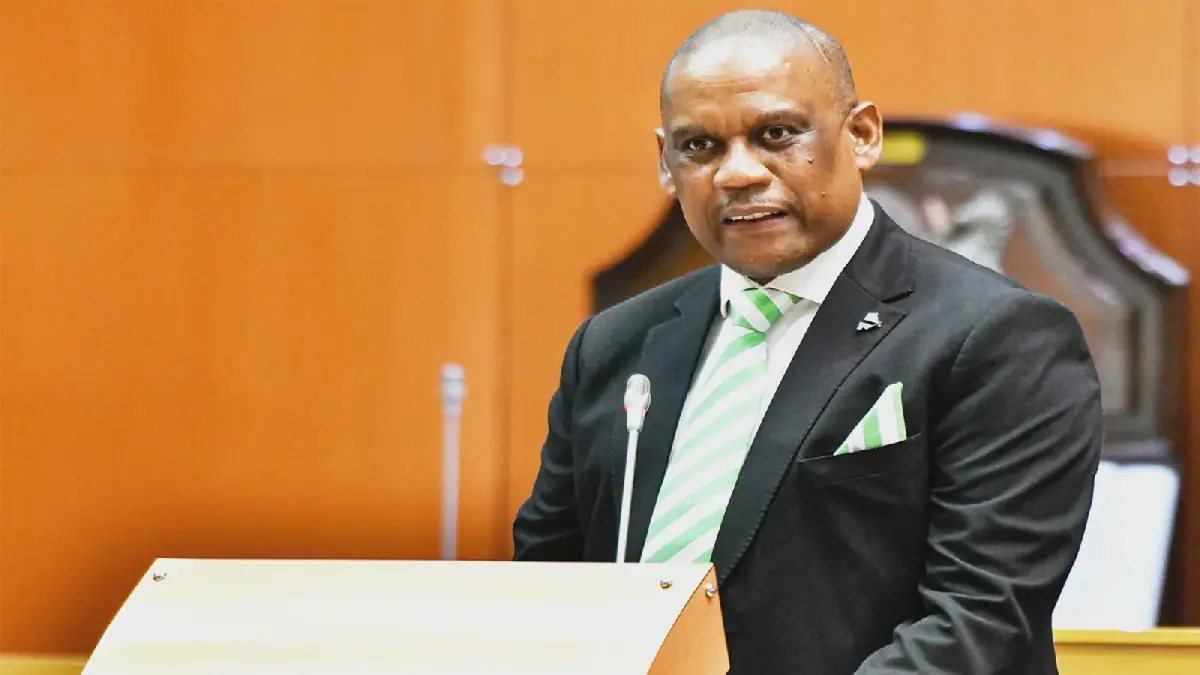
On November 11, Botswana's Leader of the Opposition, Dumelang Saleshando, delivered a response to the State of the Nation Address, focusing on an urgent intervention to address the country's economic challenges. Saleshando used a medical metaphor, comparing the economy to a patient hemorrhaging, and argued that the government should prioritize stopping the bleeding before presenting a long-term plan. He emphasized that Batswana already know their lives have become harder and what they need from the government is a way out.
Saleshando's case began with a familiar suspicion that the headline economic figures can be misleading. He noted that the economy shrank by 2.8% in 2024 and a further 0.7% in 2025, but this year's figures showed a rebound, with annual growth of 3.7% in the second quarter. However, he pointed out that this rebound was largely due to diamond mining recovering from a low base, while the non-mining economy, where most Batswana work and trade, actually contracted by 0.2%. Real household consumption fell by 7.2% over the year, according to Econsult.
The Leader of the Opposition also expressed skepticism about the public finances, noting that the government's revised deficit for this year is sharply downward, from P26.35 billion to roughly P9.3 billion. However, he argued that P8.1 billion of that improvement was due to a one-off windfall, a P7.3 billion distribution from the Bank of Botswana. Saleshando emphasized that a one-off windfall is not a sustainable solution and that the country's dependency on diamonds has not changed, with diamonds still supplying about a third of government revenue and three-quarters of foreign exchange.
Saleshando proposed a six-point Economic Rescue Plan to address the country's economic challenges. The plan includes targeted VAT relief on essential goods, a moratorium on new or increased levies on low- and middle-income families, and a cost-containment and reprioritization plan from the Ministry of Finance. He also called for engagement with organized labor on a cost-of-living adjustment and a minimum-wage review, as well as a published schedule for settling verified arrears.
The Leader of the Opposition emphasized that the government cannot ask households to tighten their belts while refusing to examine its own spending. He called for the President to lead by example, recalling the early independence years when leaders traveled to international meetings with small delegations on commercial flights. Saleshando also suggested shelving plans to open new diplomatic missions, as every new mission is a permanent cost.
Saleshando's plan also focuses on fuel as a national economic risk, urging an open review of current procurement and distribution arrangements. He proposed a transparent and time-bound relief mechanism for public transport and productive sectors during price shocks and wide consultation on the draft Botswana Energy Regulatory Authority Amendment Bill. Additionally, he emphasized the need for predictability and consultation on major policy changes to boost investor confidence.
The Leader of the Opposition concluded by emphasizing that the government's promises must be kept, particularly regarding wages and arrears. He proposed that the Bank of Botswana windfall be ring-fenced for arrears and capital projects, not recurrent spending. Saleshando's six-point plan aims to provide immediate relief to households and businesses while also promoting long-term economic transformation and diversification.
Key points
- The plan includes targeted VAT relief on essential goods and a moratorium on new or increased levies on low- and middle-income families.
- Saleshando emphasized the need for the government to lead by example in cost containment and reprioritization.
- The plan aims to promote predictability and consultation on major policy changes to boost investor confidence.