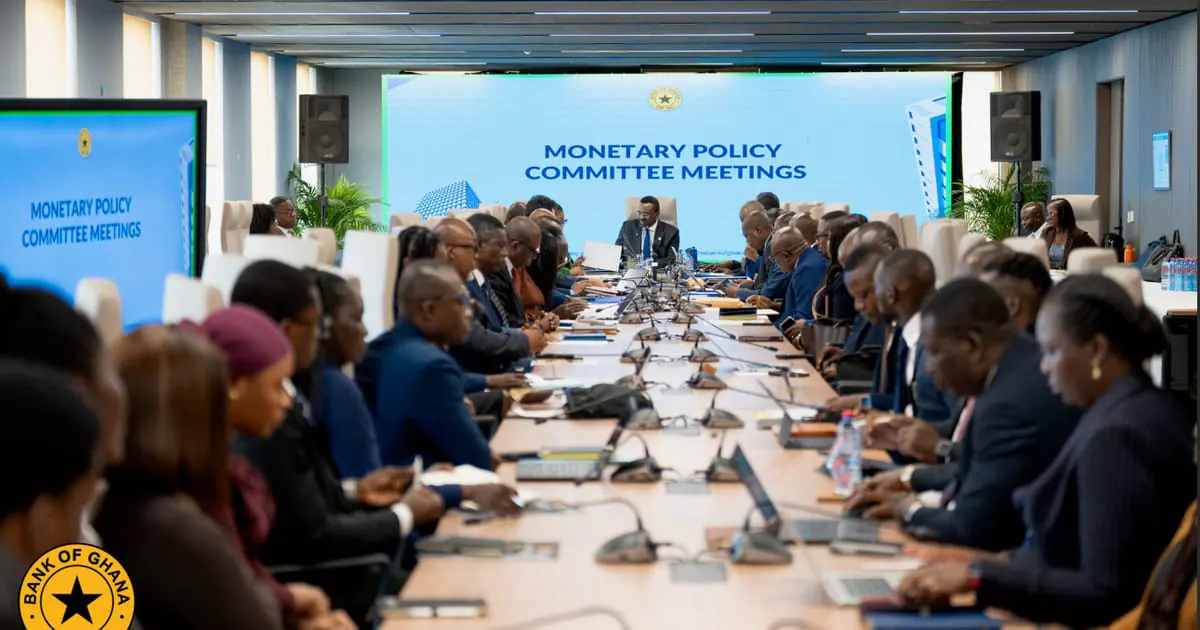
The Governor of the Bank of Ghana, Dr Johnson Pandit Asiama, has expressed concerns over the escalating Middle East crisis, which has entered its seventh month. He made these remarks during the opening of the 132nd Monetary Policy Committee (MPC) in Accra on Wednesday, September 23. According to Dr Asiama, the global economic developments are being dominated by the Middle East crisis, with hopes of a permanent ceasefire fading.
Dr Asiama noted that renewed hostilities between the United States and Iran continue to disrupt trade flows through the Strait of Hormuz. Additionally, attacks on Saudi Arabia's oil infrastructure have shut down one of the few alternative export routes. This has resulted in a highly uncertain trajectory for the conflict, with risks to global growth and inflation becoming more pronounced.
The BoG Governor stated that beyond the crude oil price shock, all forecasts indicate that the global growth outlook has deteriorated considerably since the conflict began. Growth forecasts have been downgraded, with the World Bank and United Nations projecting global growth at 2.5 percent, well below pre-pandemic norms and the International Monetary Fund's April estimate of 3.1 percent.
Dr Asiama also highlighted that emerging market and developing economies face particularly weak per capita income growth. The Middle East and North Africa region has recorded cumulative growth revisions of nearly three percentage points. Meanwhile, global headline inflation is picking up due to rising energy and agricultural input prices.
Brent crude prices have increased, rising to about US$107 per barrel last week, its highest level in four months. This price increase occurs against a backdrop of depleted global inventories, leaving markets with less capacity to absorb further supply shocks. Several central banks that had commenced easing cycles have consequently paused or reversed course.
Dr Asiama noted that tighter global financial conditions and a stronger US dollar have weighed on emerging market currencies, including the cedi. For Ghana, the global shock is double-edged, with higher gold prices providing support for export earnings, reserve accumulation, and government revenue. However, higher energy and fertiliser import costs could feed through quickly to transport, production costs, and consumer prices.
Despite the external challenges, Dr Asiama indicated that domestic macroeconomic conditions remain stable and broadly positive. Headline inflation, at 5.0 percent in August, is well below the lower bound of the 8±2 percent band. Real GDP grew by 6.0 percent in the second quarter, led by services and ICT. The fiscal position is stronger than programmed, with a primary surplus above target and debt at 45 percent of GDP.
Key points
- The BoG Governor cited renewed hostilities between the US and Iran as a major factor disrupting trade flows through the Strait of Hormuz.
- Dr Asiama noted that global growth forecasts have been downgraded to 2.5 percent, well below pre-pandemic norms.
- Despite external challenges, Ghana's domestic macroeconomic conditions remain stable, with headline inflation at 5.0 percent in August.