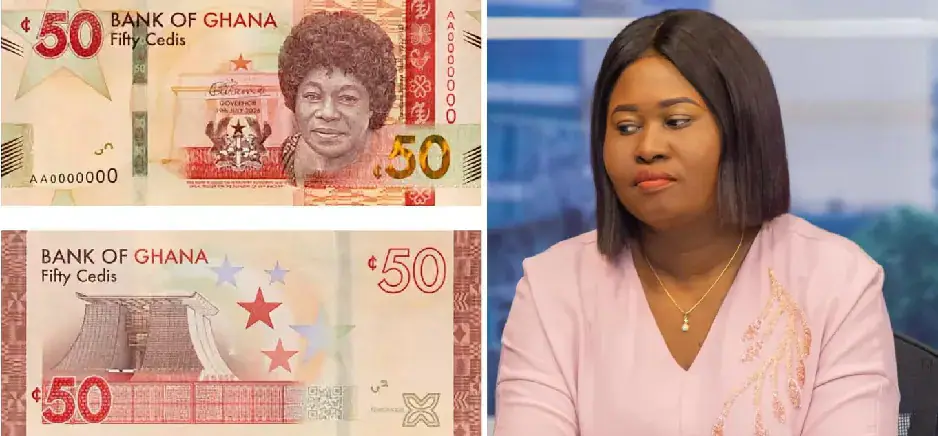
A Bank of Ghana board member, Beatrice Feehi Annangfio, has clarified that the portrait of Theodosia Salome Okoh on the new GH¢50 banknote was developed using three authentic photographs of her. The central bank aimed to produce a bold, clear, and dignified image worthy of her place in Ghana's history. This explanation came after a public debate sparked by concerns from Okoh's family about the accuracy of the illustration.
The composite artistic process involved combining two photographs from Mrs. Okoh's younger years with a third image taken later in her life. This approach allowed illustrators to depict Mrs. Okoh as a mature woman while preserving a faithful family resemblance. Artists also modified her hairstyle to reflect her family's traditional look and establish a sharper silhouette for the printing plates.
The clarification was made in response to remarks from Professor Eddie Obeng, a nephew of Mrs. Okoh, who questioned the accuracy of the illustration shortly after the currency's debut. Obeng observed that the engraving bore a stronger resemblance to his own mother, Dr. Letitia Eva Takyibea Obeng, than to his aunt. His comments sparked widespread discussion regarding how historical figures are represented on national tender.
Annangfio stated that the central bank is actively engaging with members of the Okoh family to resolve any lingering concerns. Officials intend to walk relatives through the technical steps of the design process to address their concerns. The central bank's direct outreach to the Okoh family will likely shape public reception of the redesigned currency.
Banknote portraiture requires specialized artistic adjustments that set it apart from standard photography. Annangfio explained that currency images must be sharp, well-lit, and rich in fine detail. These strict visual parameters are necessary to accommodate engraving and raised printing techniques, as well as embed complex anti-counterfeiting features directly into the portrait.
The updated GH¢50 bill anchors the broader Ghana Cedi Heritage Series, which President John Dramani Mahama officially unveiled on November 12, 2026. The redesigned currency honors key figures from Ghana's past, including Mrs. Okoh, who designed Ghana's red, gold, and green flag upon its independence in 1957. The new notes celebrate Ghana's history and cultural identity through historic sites and national symbols.
The new banknotes are scheduled to enter public circulation on December 1, 2026. Existing cedi notes will remain valid legal tender alongside the new series throughout the transition period. As the December launch approaches, the central bank's engagement with the Okoh family and the public's reception of the redesigned currency will be closely watched.
Key points
- The Bank of Ghana used three authentic photographs to develop Theodosia Okoh's portrait for the new GH¢50 banknote.
Reporting sources
- BoG worked with three authentic photos of Theodosia Okoh for GH¢50 banknote portrait, board member clarifies · Ghana Broadcasting Corporation