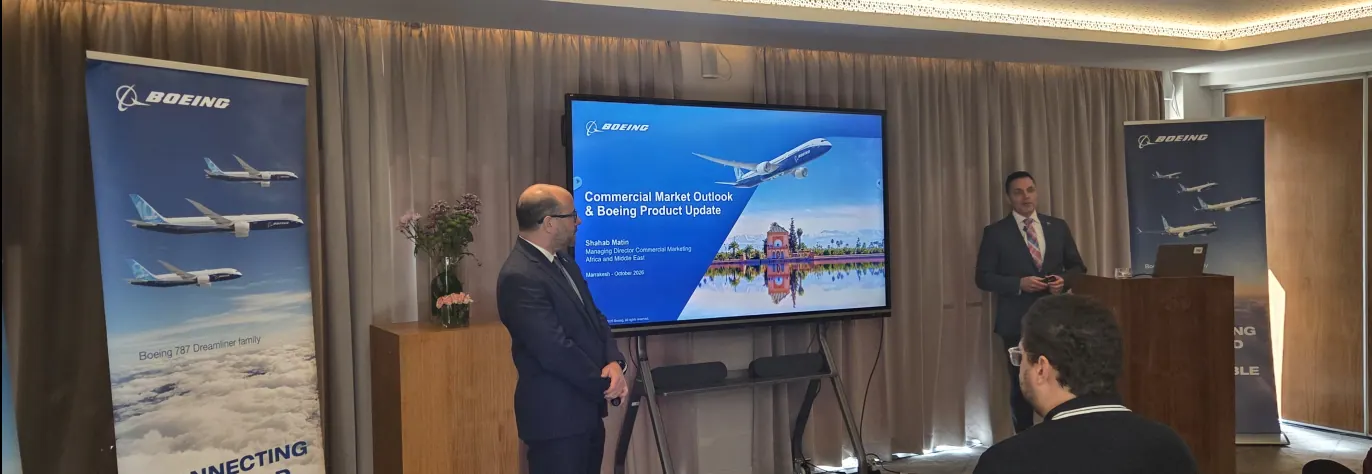
Boeing has released its Commercial Market Outlook 2026-2045, predicting African air traffic to grow at an average annual rate of 5.8% over the next two decades, surpassing the global average of 4%. This growth is expected to be driven by a 3.8% annual economic growth rate, demographic changes, and urbanization. Shahab Matin, Managing Director Commercial Marketing for Middle East & Africa at Boeing, presented the outlook on October 6 in Marrakech, Morocco.
The African commercial air fleet is projected to increase from 755 aircraft in 2025 to 1,625 by 2045, with 1,165 new deliveries expected between 2026 and 2045. Narrow-body aircraft will account for 870 of these deliveries, or 75% of the total, while 240 wide-body aircraft and 40 regional aircraft are also anticipated. The growth in air traffic and fleet expansion will create significant demand for maintenance, services, and qualified personnel.
Boeing forecasts that over 1 billion Africans will live in urban areas by 2037, driving demand for air travel. The existing 45 million Africans living outside their home countries also contribute to air travel growth, particularly for family visits. As a result, African airlines will require a substantial number of new aircraft to meet increasing demand, with narrow-body aircraft playing a key role in developing domestic, intra-African, and European routes.
The African air market is expected to experience faster growth than the global sector over the next two decades. By 2045, Boeing predicts that only 125 of the current 755 aircraft in service will still be operational, with 92% of the African fleet consisting of newer, more efficient aircraft. This renewal will be driven by the need for more efficient and environmentally friendly aircraft.
According to Shahab Matin, the African market has distinct characteristics, with nearly 70% of new aircraft deliveries expected to support capacity growth, compared to around 50% globally. This growth will be driven by increasing demand for air travel, particularly on intra-African routes. The development of these routes will be crucial in driving economic growth and connectivity across the continent.
Boeing's forecast also highlights the importance of addressing environmental concerns, such as decarbonization, in the aviation industry. The company is working to develop more sustainable aircraft and explore alternative fuels. Additionally, the rise of China as a potential competitor to Boeing and Airbus is being closely monitored, with Matin noting the importance of innovation and customer support in maintaining market share.
In conclusion, Boeing's Commercial Market Outlook 2026-2045 predicts significant growth for the African air market, driven by increasing demand for air travel and a growing economy. With 1,165 new aircraft expected to be delivered by 2045, the African air fleet is set to double, creating opportunities for airlines, manufacturers, and service providers.
Key points
- African air traffic is expected to grow at an average annual rate of 5.8% over the next two decades.
- Boeing forecasts 1,165 new aircraft deliveries to African airlines between 2026 and 2045.
- The African air fleet is expected to double by 2045, reaching 1,625 aircraft.