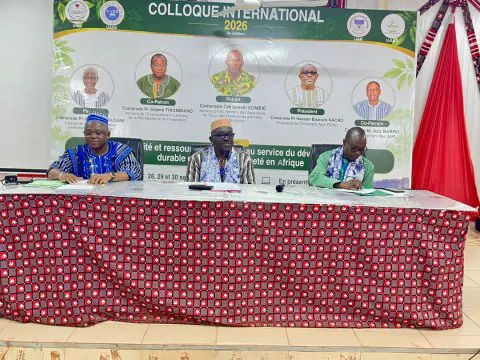
The 3rd International Colloquium on Biodiversity and Natural Resources kicked off on September 28, 2026, in Bobo-Dioulasso, Burkina Faso. The three-day event, co-organized by the University Nazi Boni of Burkina Faso, the University Alioune Diop of Senegal, the University Abdou Moumouni of Niger, and the University Jean Lorougnon Guédé of Côte d'Ivoire, brings together researchers, teachers, students, and experts. They will discuss the theme "Biodiversity and Natural Resources for Development and Sovereignty in Africa."
The colloquium features around 170 scientific communications over three days, covering topics such as biodiversity, terrestrial ecosystems, forest and water resources, agricultural lands, fishery resources, and mineral resources. According to Professor Bilassé Zongo, President of the Organizing Committee, the event aims to facilitate dialogue, reflection, and the sharing of experiences to construct endogenous African solutions. The goal is to ensure that scientific research findings contribute more significantly to public decision-making and community development.
Professor Hassan Bismarck Nacro, President of the University Nazi Boni, emphasized that the chosen theme has far-reaching implications beyond the academic sphere. He noted that Africa is rich in fauna, flora, and mineral resources, but paradoxically faces persistent difficulties in leveraging these resources for development. The challenge, he said, is to transform the continent from a primarily extractive and export-oriented economy to one that focuses on knowledge, innovation, and value creation.
The participating universities aim to strengthen their scientific cooperation and promote better appropriation of natural resources by African societies. The event also includes a panel discussion with the participation of structures and enterprises to bridge the gap between research and application. On the third day, a field trip is planned to observe initiatives for valorizing natural resources and local products.
The initiative, initially led by Burkina Faso and Senegal, has expanded to include Niger and Côte d'Ivoire, reflecting a desire to strengthen African scientific integration. Professor Nacro stressed that this integration is not only political but also scientific, aiming to federate the intelligences of different countries to drive the development of their nations.
Key objectives of the colloquium include providing scientific and technical recommendations to improve biodiversity conservation, proposing public policy tracks for sustainable natural resource management, and identifying mechanisms for better economic valorization of biodiversity. The ambition is to make scientific knowledge a tool for sustainable development and sovereignty based on the mastery and valorization of the continent's riches.
The four universities involved in the colloquium hope to contribute to a better understanding and management of Africa's natural resources. By working together, they aim to harness biodiversity as a lever for sovereignty and development in Africa. The event has attracted participants from various African countries, including Mali, Benin, Togo, Guinea, Chad, and Congo.
Key points
- Four African universities have partnered to explore the potential of biodiversity and natural resources for driving development and sovereignty in Africa.
- The 3rd International Colloquium on Biodiversity and Natural Resources features around 170 scientific communications and aims to facilitate dialogue and knowledge sharing among researchers and experts.
- The event seeks to provide recommendations for improving biodiversity conservation, sustainable resource management, and economic valorization, ultimately contributing to Africa's sustainable development and sovereignty.