The Banque Nationale Agricole (BNA), a Tunisian state-owned agricultural bank, has reported improved financial ratios for the first half of 2026. According to its financial statements, the bank's classified debt ratio decreased from 22.51% to 21.59%, while the coverage of classified debts by provisions and reserved interest increased from 56.43% to 59.35%. These improvements suggest a positive trend, but a closer look at the bank's financials reveals concerns.
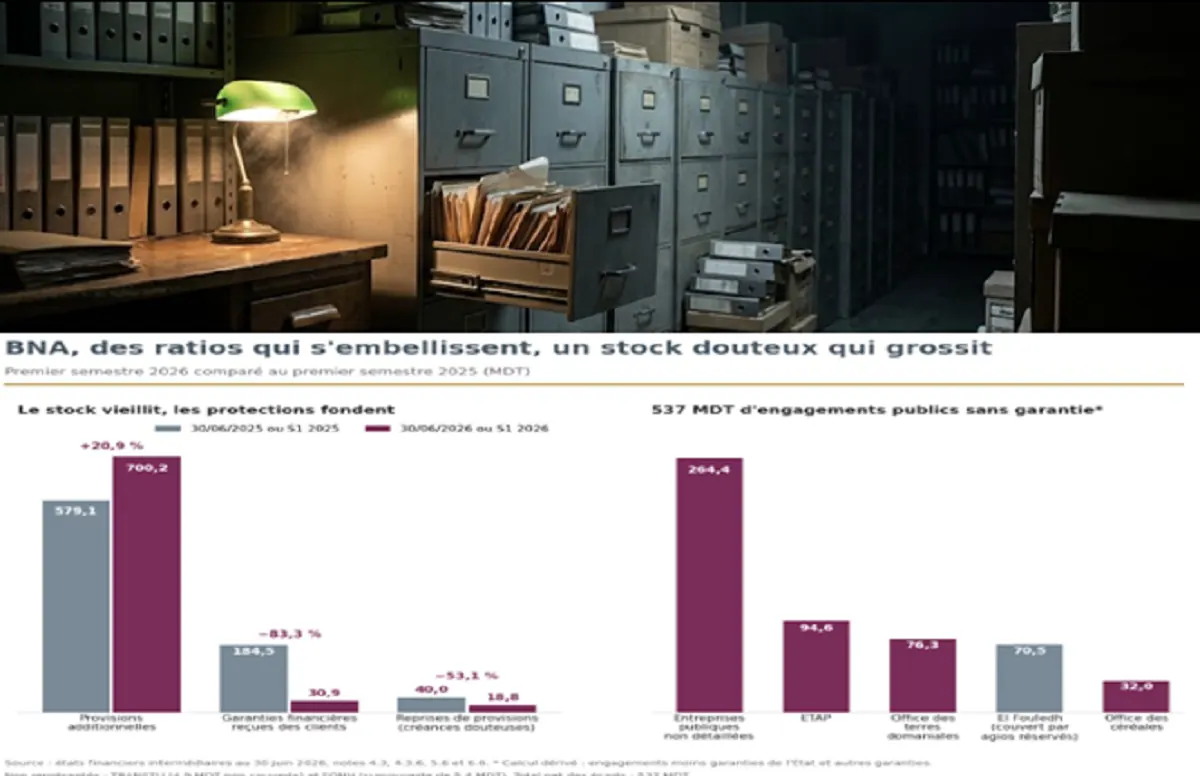
Despite the improved ratios, BNA's stock of doubtful debts continues to grow. The bank's classified debts increased by 4.6% over the past year, while its total commitments rose by 9.1%. The most degraded category of debts, class 4, reached 4,045 million Tunisian dinars (MDT), a 5.5% increase. This category accounts for 96% of the bank's classified debts. Furthermore, the age of these debts is a concern, with provisions for debts that have been in class 4 for at least three years increasing by 20.9% to 700 MDT.
The bank's recoveries from doubtful debts have declined significantly. Reversals of provisions for doubtful debts, which reflect recoveries, fell by 53% to 18.8 MDT. Additionally, unpaid interest from commercial and industrial clients increased by 10.5% to 663.5 MDT, while reserved interest due but not received rose by 9% to 1,031 MDT. These trends indicate a decline in the bank's ability to recover its debts.
BNA's guarantees have also decreased. Financial guarantees received from clients plummeted by 83% to 30.9 MDT, while guarantees received from banks declined by 32.7%. The bank's public commitments, however, are backed by the state's signature. Nevertheless, there is a 537 MDT gap between the state's guarantees and the bank's commitments to public enterprises.
The bank's off-balance-sheet items also reveal some concerns. Accounts pending and regularization at the asset level increased by 47% to 347.8 MDT, while accounts related to compensation on the liability side stood at 237 MDT. The bank's provision for litigation and disputed items reached 29.2 MDT. Furthermore, a provision for penalties from the Central Bank of Tunisia (BCT) of 1.244 MDT remains unchanged since last year.
BNA's financial statements do not provide some key indicators, such as solvency ratios, net equity, liquidity ratios, or a breakdown of risks. This lack of transparency raises questions, particularly given the bank's significant public commitments, which weigh 3.6 times its equity. The bank's management will need to address these concerns to restore confidence in its financial health.
The bank's situation highlights the need for closer monitoring of its financials. While BNA's improved ratios are a positive sign, the growing stock of doubtful debts and declining recoveries are causes for concern. The bank's management will need to take steps to address these issues and improve its financial transparency to maintain confidence in its stability.
Key points
- BNA's classified debt ratio decreased from 22.51% to 21.59%.
- The bank's stock of doubtful debts continues to grow, with classified debts increasing by 4.6% over the past year.
- Recoveries from doubtful debts declined by 53% to 18.8 MDT.