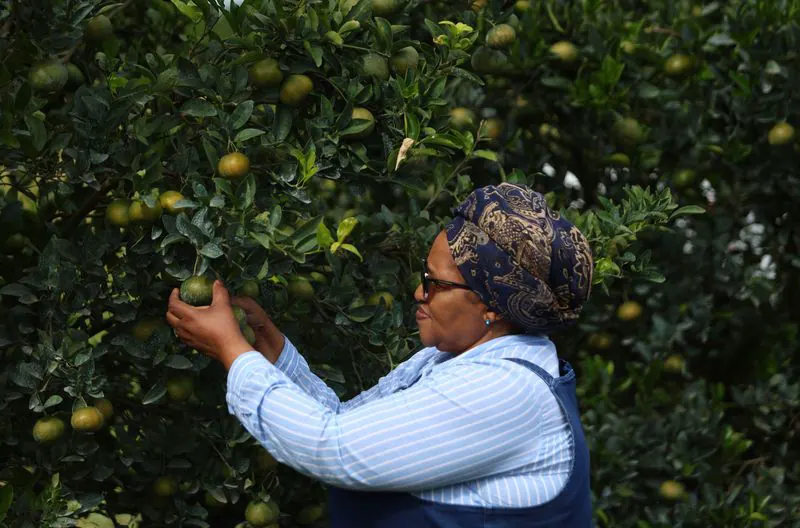
Buyiswa "Steri" Ndyenga, a 56-year-old citrus farmer, has lived on Willowtree Farm in the Eastern Cape's Sundays River Valley for over four decades. She grew up on the farm, where her mother worked, and began handpicking fruit and hauling crates as a teenager. After high school, Ndyenga returned to work at Willowtree, starting as a seasonal "ticker" and becoming a permanent worker in 1994. She later became a team supervisor and, in 2006, the South African government bought Willowtree Farm as part of a land reform initiative.
The Sundays River Valley is South Africa's largest citrus hub, with farms exporting around eight million cartons of oranges, lemons, grapefruit, and soft citrus annually. In 2025, South Africa overtook Spain as the world's leading citrus exporter, shipping a record 204 million 15kg cartons of fruit. Ndyenga's farms, including Willowtree, Siyathemba, Glengrove, and Sophumelela, comprise 421 hectares, with 378 hectares planted. In 2025, the farms exported 393,060 cartons of citrus to countries in the Far East, Middle East, and Europe.
Despite her success, Ndyenga faces challenges in the male-dominated industry. She notes that black farmers account for only around 10% of South Africa's commercial agricultural output, and women make up a small percentage of commercial farm owners or operators. However, Ndyenga enjoys the challenge of being one of the few black women farmers in the region and is currently training two women, one as an assistant farm manager and another in an administrative position.
A significant obstacle for Ndyenga is the lack of a land title deed for the farms. The Department of Rural Development and Land Reform acquired the farms in 2006 but leased the land to the Sundays' River Farming Trust instead of transferring ownership. Nearly two decades later, Ndyenga still hasn't received a title deed, which affects her ability to grow her business and secure loans from banks.
The absence of a title deed has hindered Ndyenga's business growth, and she accuses the government of playing "hide and seek" with the title deeds. She claims that officials visit the farm before elections, promising to grant title deeds, but fail to follow through once voting concludes. Land Reform Minister Mzwanele Nyhontso has promised to accelerate the handover of title deeds to empower South African farmers.
The Department of Land Reform and Rural Development spokesperson, Cassiem Khan, stated that the department is finalizing the transfer of the four properties and conducting a land right enquiry to ensure compliance with applicable land rights legislation. The department aims to conclude the outstanding Land Rights Enquiry Report by the end of June 2026, subject to cooperation from all affected parties.
As the 4 November elections approach, Ndyenga's story highlights the challenges faced by black farmers in South Africa. Despite her success in the citrus industry, she continues to struggle for a land title deed, which would enable her to grow her business and secure her financial future. The government's efforts to accelerate the handover of title deeds may bring relief to farmers like Ndyenga, but the process has been slow, and the outcome remains uncertain.
Key points
- The South African government has promised to accelerate the handover of title deeds to empower farmers.
- Black farmers account for only around 10% of South Africa's commercial agricultural output.
- The Sundays River Valley is South Africa's largest citrus hub, exporting around eight million cartons of citrus annually.