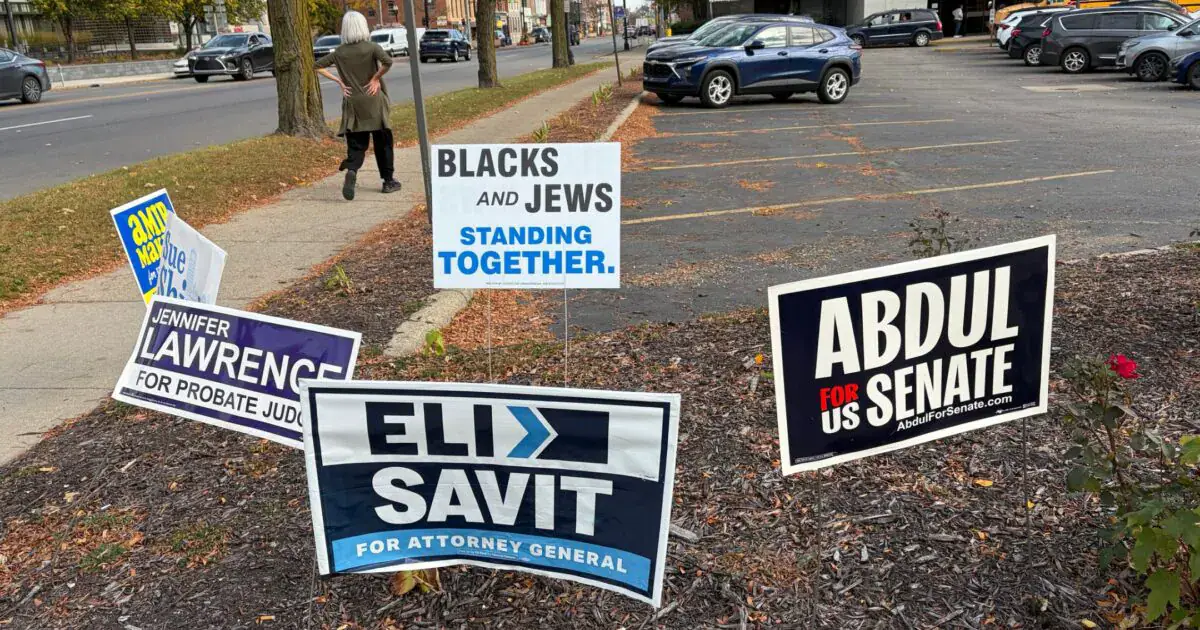
A black conservative group, the Center for Urban Renewal and Education (CURE), has been actively promoting Jewish and pro-Israel messaging in Michigan. The group, based in Washington, DC, has been distributing yard signs reading "Blacks and Jews Standing Together" in cities with large black populations, including Detroit, Flint, and Ypsilanti. The signs are part of CURE's effort to encourage black voters to support Jews and Israel. The group's director, Star Parker, stated that their goal is to remind black Christian voters of the unique and special reasons to stand with Israel.
CURE's efforts have included paying for billboards in the area with messages such as "Self Defence is Not Genocide" and "Many Black Evangelicals Agree that Israel Has a Right to Exist". The signs and billboards do not name any specific candidates, but Michigan's Democratic Senate nominee, Abdul El-Sayed, has faced challenges in shoring up support from Jewish voters due to his rhetoric on Israel and comments on Jewish safety. El-Sayed has also struggled to gain traction with black voters, a traditional Democratic constituency.
El-Sayed's primary rival, US Representative Haley Stevens, had significant support from black voters in Detroit, but a recent poll suggested that 87% of likely black voters would now support El-Sayed. Despite this, there are still tensions between black and Arab communities, as well as between Jewish and Arab populations. Sam Robinson, a Detroit-based reporter, noted that there is a scarcity mindset among some black voters who feel that Arabs are taking away resources from black people.
Republican candidate Mike Rogers has actively courted black voters, as well as Jewish ones, with pro-Rogers ads highlighting tensions between local black and Arab communities. A new super PAC linked to Rogers has spent heavily on ads stating that El-Sayed has been disrespectful and dishonest with black voters. CURE's signs targeting black voters appeared in the final week of the campaign, following a 22 October interfaith roundtable in Detroit hosted by the organisation.
The interfaith roundtable, which included a local rabbi alongside black pastors, discussed the history of black-Jewish organising, a long-time alliance that has been shaken in recent years. Rabbi Aaron Bergman of Adat Shalom, a Conservative synagogue in Farmington Hills, participated in the CURE roundtable and stated that the event was primarily about teaching about antisemitism, which he believes is now a political issue.
El-Sayed has focused on shoring up the black vote in the final stretch of the campaign, visiting black churches and holding events with former President Barack Obama and senior US Representative Jim Clyburn. Driving up turnout in black communities is seen as crucial to El-Sayed's chances of winning the seat. Meanwhile, Stevens' last-minute decision to endorse Rogers is seen as a wildcard, with Star Parker believing that many black Christian voters will follow her lead.
However, there are signs that Palestinian rights may be a more significant issue among Michigan's black voters this year than in the past. Pro-Palestinian state Representative Donavan McKinney won his primary challenge against a pro-Israel incumbent in a majority-black, Detroit-area congressional district in August. The issue may play a role in the Senate race, with some black voters potentially swayed by candidates' stances on Israel and Palestine.
Key points
- CURE's efforts aim to remind black Christian voters of the unique and special reasons to stand with Israel.
- El-Sayed faces challenges in shoring up support from Jewish and black voters.
- The issue of Palestinian rights may be a significant factor in the Senate race among Michigan's black voters.