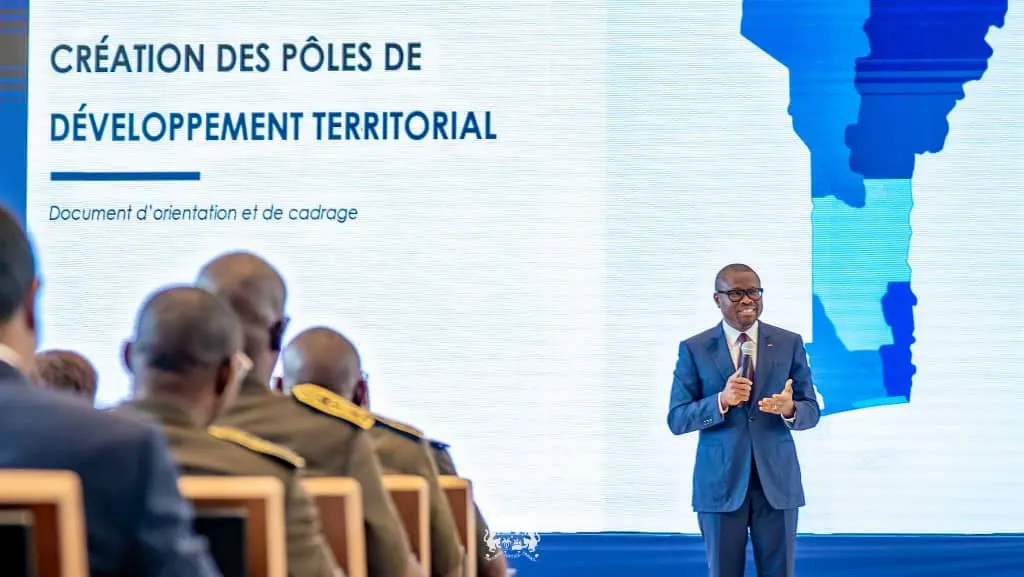
The government of Benin has unveiled a comprehensive territorial reform plan aimed at promoting economic development and decentralization. The plan, presented on September 23, 2026, involves the creation of six development poles, each comprising several communes. The poles are designed to be economically viable and will be supported by a Delegate General responsible for identifying and valorizing the territory's economic assets.
The reform maintains the existing 77 communes, which will retain their mayors, councils, and executive secretaries. The communes will play a crucial role in the new system, serving as the primary providers of ideas and projects for their respective poles. They will be responsible for showcasing their local assets, developing projects, and participating in concertation. In return, they will receive support for their projects, coordination, and assistance in mobilizing financing.
The six development poles are: Grand-Nokoué, Sud-Est, Sud-Ouest, Centre, Nord-Est, and Nord-Ouest. Each pole will have a unique economic vocation, such as the Nord-Est pole, which will focus on livestock and logistics, while the Sud-Est pole will develop agro-industry. The poles will be required to develop four key components: productive agriculture, industry, tourism, and innovation.
The Delegate General, a new position created by the reform, will be responsible for coordinating the various actors involved in the projects and ensuring the coherence of interventions on their territory. The Delegate General will not have hierarchical power over prefects or mayors but will ensure institutional coordination between stakeholders.
The National Committee, chaired by the President of the Republic, will provide guidance, arbitration, and oversight of the reform. The committee will comprise government members, six Delegate Generals, and a representative of the National Association of Benin's Communes. A Permanent Secretariat will provide coordination and technical support to the committee.
The implementation of the reform will follow a four-stage process. The first stage, set to begin in the fourth quarter of 2026, will involve the installation and launch of the new structures, including the appointment of Delegate Generals and the constitution of teams. The subsequent stages will focus on structuring attractiveness, planning, and deployment.
The government aims to complete the reform within 12 months, with each pole having a contract outlining responsibilities and a dashboard to track results. The reform is expected to enhance decentralization, promote economic growth, and improve the living standards of Benin's citizens.
Key points
- The reform maintains the existing 77 communes, which will retain their mayors, councils, and executive secretaries.
- Each development pole will be required to develop four key components: productive agriculture, industry, tourism, and innovation.
- The National Committee, chaired by the President of the Republic, will provide guidance, arbitration, and oversight of the reform.