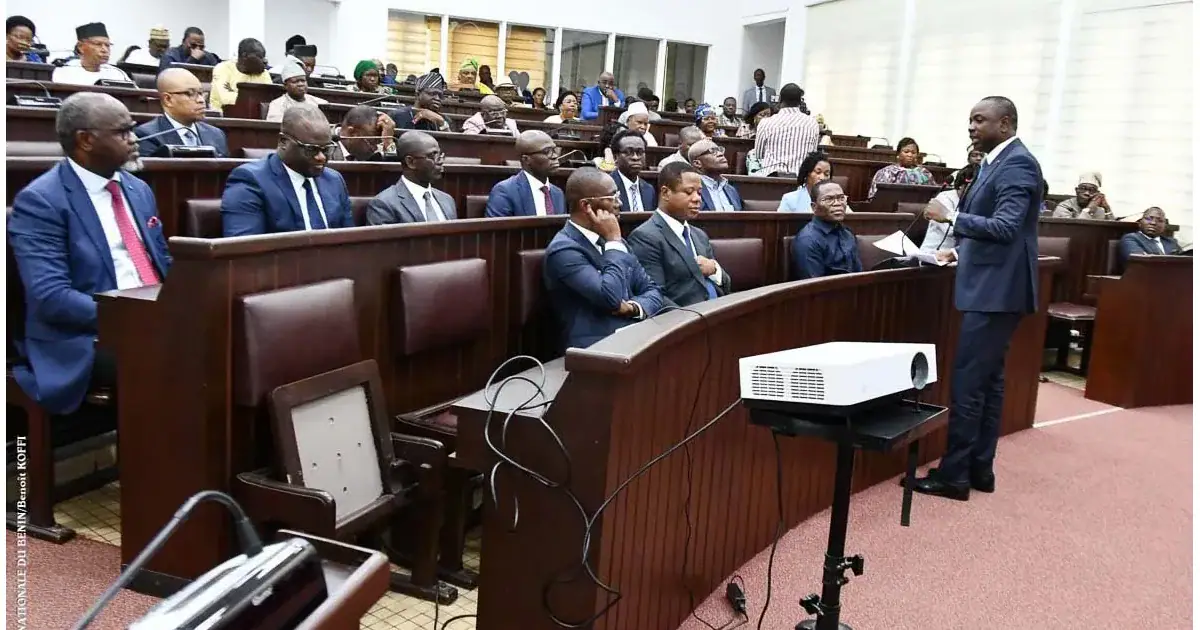
The Beninese government, through the Minister of Economy and Finance, has presented the 2027 budget bill to the National Assembly's budget commission. The proposed budget stands at 4,757.029 billion FCFA, marking a 14.7% increase from the 2026 revised budget of 4,148.357 billion FCFA. This first budget of the new seven-year term aims to drive economic growth, reduce poverty, and transform the national economy.
The 2027 budget allocates 1,545.2 billion FCFA to public investment programs, with economic projections indicating a 7.5% growth rate, a 2.8% budget deficit, and 2% inflation. The government plans to finance 80% of the budget through its own resources. As of September 2026, the state had mobilized 1,828 billion FCFA in revenue, achieving a 66.8% realization rate.
A significant portion of the budget, 1,597.5 billion FCFA, is dedicated to social spending, up from 1,285.37 billion FCFA in 2026. The government plans to expand the national school canteen program to benefit 1.9 million students and maintain free secondary and technical education for young girls. Additionally, monetary transfers to vulnerable populations will be strengthened through existing social programs like Gbéssoké.
The 2027 budget also prioritizes key sectors such as agriculture, industry, tourism, culture, and digital development. The government will continue to develop six territorial poles, improve water and electricity infrastructure, and focus on national security and border areas. The expansion of the Glo-Djigbé Industrial Zone, promotion of local production, and use of artificial intelligence are also part of the budget plans.
To support businesses and stimulate economic activity, the 2027 budget bill includes measures to sustain and extend existing tax exemptions, such as those for new vehicles, domestic gas, and equipment for small and medium-sized enterprises. The bill also introduces 14 new fiscal provisions aimed at modernizing the tax system, including a TVA and customs duty exemption for local e-commerce operations with command values not exceeding 300,000 FCFA.
The government aims to simplify land and digital taxation, operationalize the Communal Investment Fund, and establish an economic territorial division mechanism. These measures seek to diversify financing options for municipalities and empower them to undertake more significant projects.
The budget plan reflects the government's commitment to improving the business environment, promoting economic growth, and enhancing social welfare. The implementation of these initiatives will be closely monitored to assess their impact on the economy and the lives of Beninese citizens.
Key points
- The 2027 budget focuses on economic growth, poverty reduction, and national economy transformation.
- The budget allocates 1,545.2 billion FCFA to public investment programs.
- The government plans to finance 80% of the budget through its own resources.
Reporting sources
- Ce que prévoit le projet de loi de finances gestion 2027 · 24haubenin.info