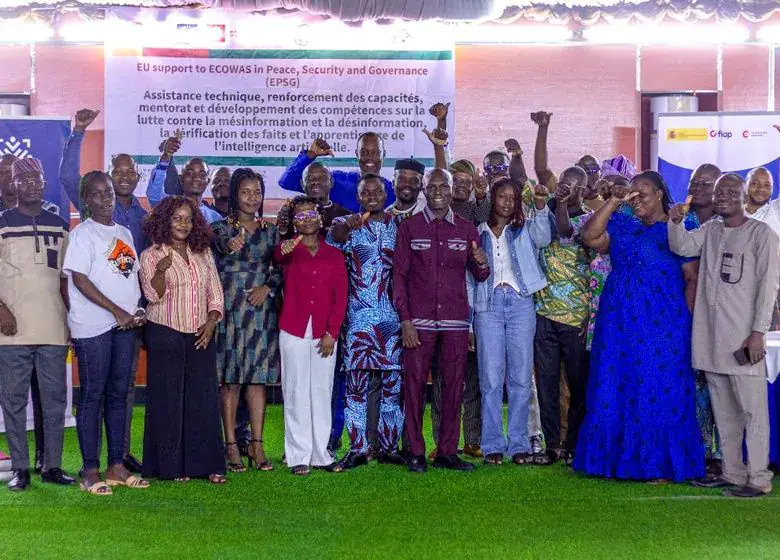
The FIAP and Banouto have organized a training workshop in Cotonou, Benin, to equip local information actors with the skills to combat misinformation in local languages. The three-day workshop, which took place from November 16 to 18, 2026, brought together 25 participants, including journalists, radio animators, community relays, content creators, and influencers who produce or disseminate content in local languages. The training aimed to enhance their capacity to identify, verify, and counter false or misleading information on digital platforms and in community exchanges.
According to Léonce Gamaï Davodoun, Manager General of the Banouto Group, local languages play a vital role in accessing information, particularly in communities where radio, social media, and interpersonal exchanges are significant communication channels. However, these spaces can also facilitate the rapid spread of false or misleading information, which can fuel misunderstandings, mistrust, and community tensions. Davodoun emphasized that combating misinformation requires strengthening the competencies of actors who produce and/or relay information in local languages.
The training focused on enhancing the participants' skills to verify information, use digital tools and artificial intelligence judiciously, and adapt their findings to the linguistic and sociocultural realities of their audiences. The participants learned how to structure effective verification content, which relies on four key elements: a relevant hook, visible and verifiable evidence, a nuanced verdict, and a call to action to raise public awareness. They also examined and verified various videos and studied radio productions and Facebook content designed to deconstruct false information and counter reality distortions.
During the workshop, the participants were divided into five groups and practiced combating misinformation by examining and verifying different videos provided by the facilitator, Judicaël Kpèhoun. Each group worked on a rumor submitted for analysis, and their verification exercises revealed the methods used to distort and manipulate information. The training also covered the use of digital tools and artificial intelligence to examine and verify texts, images, and videos.
The workshop is part of the EPSG project implemented by FIAP and Banouto, a multi-donor initiative co-financed by the European Union, the German Federal Ministry for Economic Cooperation and Development, and the Danish Ministry of Foreign Affairs. The FIAP is responsible for implementing the project's third component in West Africa, in partnership with the German Development Cooperation (GIZ), with a focus on strengthening electoral processes, preventing electoral violence, and combating misinformation, disinformation, and hate speech.
The training is expected to enable participants to better understand the forms of misinformation, their online and offline circulation patterns, and their consequences on peace and social cohesion. They will also master the main methods of verifying information, cross-checking sources, and using digital tools and artificial intelligence to produce and disseminate reliable content adapted to their audiences and sensitive to peace and social cohesion issues.
By enhancing the capacities of local information actors, the FIAP and Banouto aim to contribute to the development of effective strategies to combat misinformation in Benin. The training is a significant step towards promoting fact-based information and mitigating the risks associated with the spread of false information in local languages. The participants are expected to play a crucial role in promoting peace and social cohesion in their communities.
Key points
- 25 local information actors trained to combat misinformation in local languages
- Training aimed to enhance capacity to identify, verify, and counter false information
- Initiative part of the EPSG project, co-financed by the European Union and other donors