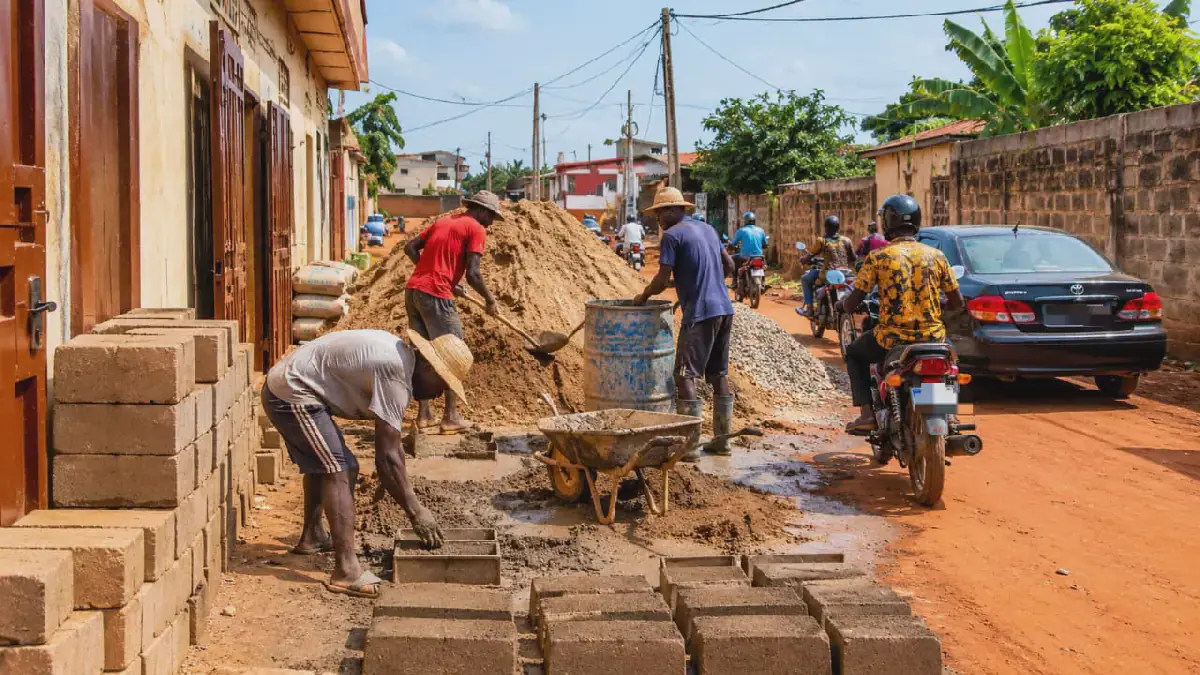
In several cities across Benin, private construction projects are sprawling onto public roads, transforming them into open-air depots for construction materials. This unauthorized occupation of public spaces is causing significant disruptions to urban mobility, with roads becoming increasingly narrow and treacherous for users. The situation is particularly dire in areas with high foot traffic, such as near schools.
A notable example of this issue can be seen in Agori, a neighborhood in Abomey-Calavi. A von, a type of public road, has been partially occupied by a construction site, with workers producing bricks and excavating foundations. The site is cluttered with construction materials, including bricks, sand, and cement, making it difficult for users to navigate the road. Despite the challenges posed, workers continue their activities, seemingly unaware of the risks they pose to road users.
This phenomenon is not isolated to Agori, as numerous neighborhoods across Benin are experiencing similar issues. The construction of private homes and businesses is leading to the encroachment of public roads, with vons being converted into dumping grounds for construction materials. This not only complicates traffic flow but also raises concerns about the safety of road users.
The Beninese government has established laws and regulations to govern the occupation of public spaces. The 2013 Land and Domain Code stipulates that public roads belong to the artificial public domain, and their use is subject to regulations. The code also grants mayors the authority to grant permits for the occupation of public spaces, which can be revoked at any time for public interest reasons.
Despite these regulations, the unauthorized occupation of public roads by construction sites persists. A 2015 decree outlines the conditions and modalities for occupying public spaces, requiring applicants to submit a dossier, including a request, a sketch of the area, and an indication of the intended use and duration of occupation. However, it remains unclear whether mayors are taking these requirements into account when issuing construction permits.
The consequences of inaction are far-reaching, with the city's mobility and safety being severely impacted. The situation calls for urgent attention from authorities to enforce existing regulations and find solutions to this growing problem. Effective measures would require collaboration between local government, construction stakeholders, and law enforcement agencies.
To address this issue, the Beninese government must prioritize the enforcement of existing laws and regulations. This could involve launching public awareness campaigns, strengthening the capacity of local authorities, and implementing more effective monitoring and enforcement mechanisms. By taking a proactive approach, the government can mitigate the negative impacts of private construction on urban mobility and ensure a safer, more efficient transportation network for all users.
Key points
- Benin's urban mobility is being severely impacted by private construction sites encroaching on public roads.
- The Beninese government has established laws and regulations to govern the occupation of public spaces, but enforcement remains a challenge.
- Effective measures will require collaboration between local government, construction stakeholders, and law enforcement agencies.
Reporting sources
- Mobilité urbaine : Les chantiers privés rognent les vons · Bénin Intelligent