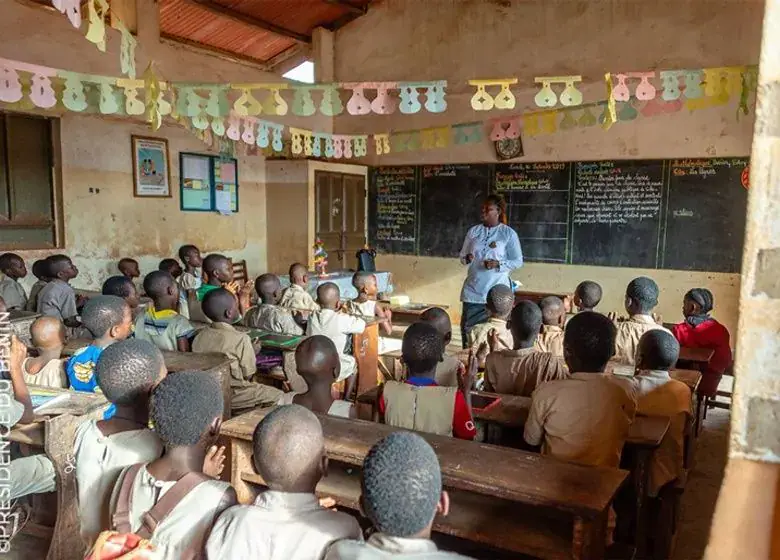
A recent report by the CONFEMEN's Program for the Analysis of Educational Systems has evaluated the skills of primary school teachers in 16 African countries, including Benin. The report, titled "The Skills of Primary School Teachers in Sub-Saharan Africa," reveals that Benin's teachers excel in reading, with a score of 532.6 points, significantly higher than the average score of 476 points for all evaluated countries. This places Benin among the top-performing countries in reading, alongside Senegal, Côte d'Ivoire, Gabon, and Djibouti.
In mathematics, Benin's teachers also performed well, with a score above the international reference average of 469.4 points. The country is among the top-ranked countries in this subject, tied with Senegal. However, a closer look at the distribution of teachers' skills reveals a significant disparity. While 69% of Benin's teachers reached level 3 in reading comprehension, only 45% achieved the same level in mathematics. This indicates that while teachers have a good grasp of the material, their performance in mathematics is less strong than in reading.
The report highlights that having strong disciplinary skills is not enough to guarantee effective teaching. It also evaluates teachers' ability to choose adapted activities, understand students' difficulties, and interpret their errors to provide remedies. International results show that teachers struggle in these areas, with an average of 43.8% of questions answered correctly in mathematics regarding analysis of a student's approach and 33.2% regarding interpretation of errors. In Benin, the report also identifies weaknesses in initial training, with 19% of teachers reporting no training in pedagogy.
The report notes that 46.1% of teachers with five years of experience or less reported no pedagogical training, indicating challenges in integrating new teachers into the profession. However, 77% of Benin's teachers reported having access to continuous training. The report emphasizes that the content of these trainings must address observed classroom needs and allow teachers to evolve their practices. This suggests that while training opportunities exist, their quality and relevance are crucial to improving teaching skills.
The situation in Benin reflects a broader trend in the region. The report finds that teachers' skills vary significantly from one country to another and that disciplinary knowledge is generally better mastered than certain didactical skills. The disparities between countries are considerable, making it impossible to propose a single solution for all educational systems. The report aims not to criticize teachers but to better understand their needs and what the educational systems provide to support them.
The CONFEMEN emphasizes that the report's goal is to "make visible what their profession demands, and what educational systems give them to respond." By highlighting areas of strength and weakness, the report seeks to inform strategies for improving teacher training and support. In Benin's case, the findings suggest a need to focus on enhancing mathematics skills and providing more effective pedagogical training for teachers.
Ultimately, the report underscores the importance of ongoing evaluation and support for teachers to ensure they have the skills needed to provide high-quality education. By addressing these challenges, educational systems can work towards improving learning outcomes for students. The report's findings serve as a valuable resource for policymakers and educators seeking to enhance the quality of teaching in Benin and beyond.
Key points
- Benin's primary school teachers excel in reading but struggle with math skills, according to a report by the CONFEMEN's Program for the Analysis of Educational Systems.