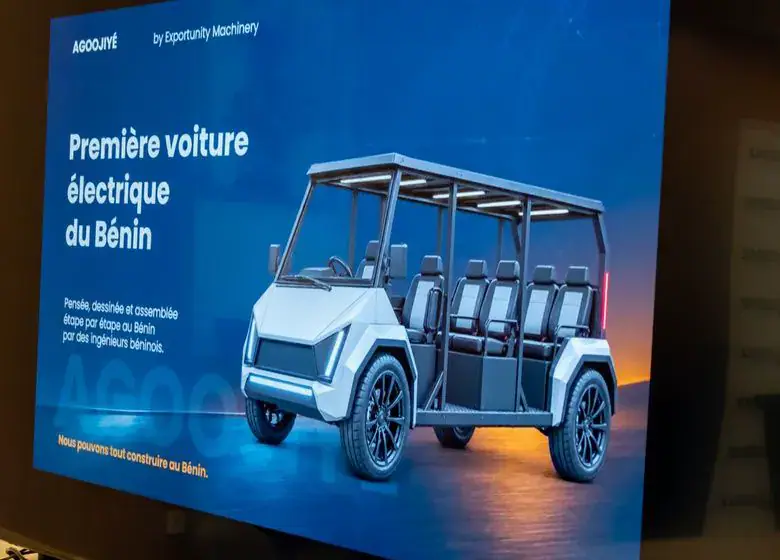
Benin's first electric vehicle, Agoojiyè, is nearing completion with 98% of its bodywork and 96% of its mechanical components finished. Developed by Exportunity Machinery SAS with support from the Glo-Djigbé Industrial Zone (GDIZ) in Benin, the vehicle was presented to the press on November 9, 2026. Technicians are currently working on integrating the electric motor, battery kits, and electrical circuit. The vehicle is expected to undergo its first driving tests by the end of November.
Agoojiyè is an 8-seater electric vehicle designed for use within the GDIZ, with a limited speed of 30 km/h to prevent speeding. According to Christian Hounkponou, lead engineer on the project, the vehicle is adapted for people with reduced mobility and has an autonomy of 36 km. The vehicle is also equipped with solar panels to ensure sustainable energy supply. The project aims to provide a solution to mobility issues within the industrial zone, where over 25,000 people work.
The Agoojiyè project began on June 10, 2026, with a challenge involving 85 students from various technical training institutions in Benin. The students worked on the vehicle's design, technical diagrams, and electrical device with Exportunity Machinery's engineers. The goal was to create a design that meets the needs of the GDIZ. After this phase, engineers and students from Exportunity Machinery, SIAB, and the Polytechnic School of Abomey-Calavi (EPAC) assembled the vehicle's first pieces over 12 days.
The vehicle was then transferred to EPAC, where students and teachers continued working on it, verifying diagrams and testing theoretical calculations. According to Vital Sounouvou, president of Exportunity Machinery SAS, this collaboration demonstrates the capabilities of local human resources. The project also aims to produce 680 vehicles for the GDIZ to address mobility issues within the zone.
Létondji Beheton, managing director of the Benin Industrial Investment and Promotion Society (SIPI-BENIN SA), which manages the GDIZ, expressed his support for the project. He emphasized the need for solutions to mobility problems within the industrial zone. Beheton also sees potential for the electric vehicle beyond the GDIZ, such as transporting tourists to various sites.
The Agoojiyè project's development demonstrates the potential for local innovation and collaboration in Benin. With its completion, the vehicle is expected to provide a clean and efficient mode of transportation within the GDIZ. The project's success could also pave the way for future electric vehicle production in Benin.
As the project nears its final stage, the GDIZ and Exportunity Machinery SAS are working together to ensure its success. With a goal of producing 680 vehicles, the project has the potential to significantly impact mobility within the industrial zone and beyond.
Key points
- The Agoojiyè electric vehicle is 98% complete and expected to undergo its first driving tests by the end of November.
- The vehicle is designed for use within the GDIZ, with a limited speed of 30 km/h and an autonomy of 36 km.
- The project aims to produce 680 vehicles for the GDIZ to address mobility issues within the zone.