The project FiSeLAE, supported by the French Ministry for Europe and Foreign Affairs through the French Equipment Fund, was implemented in Benin from July 2024 to November 2026. The project was coordinated by the Centre de coopération internationale en recherche agronomique pour le développement (Cirad). Its primary objective was to make legumes a key driver of sustainable agricultural transformation in Benin. The project operated in five communes: Djidja, Savalou, Glazoué, Tchaourou, and N'Dali.
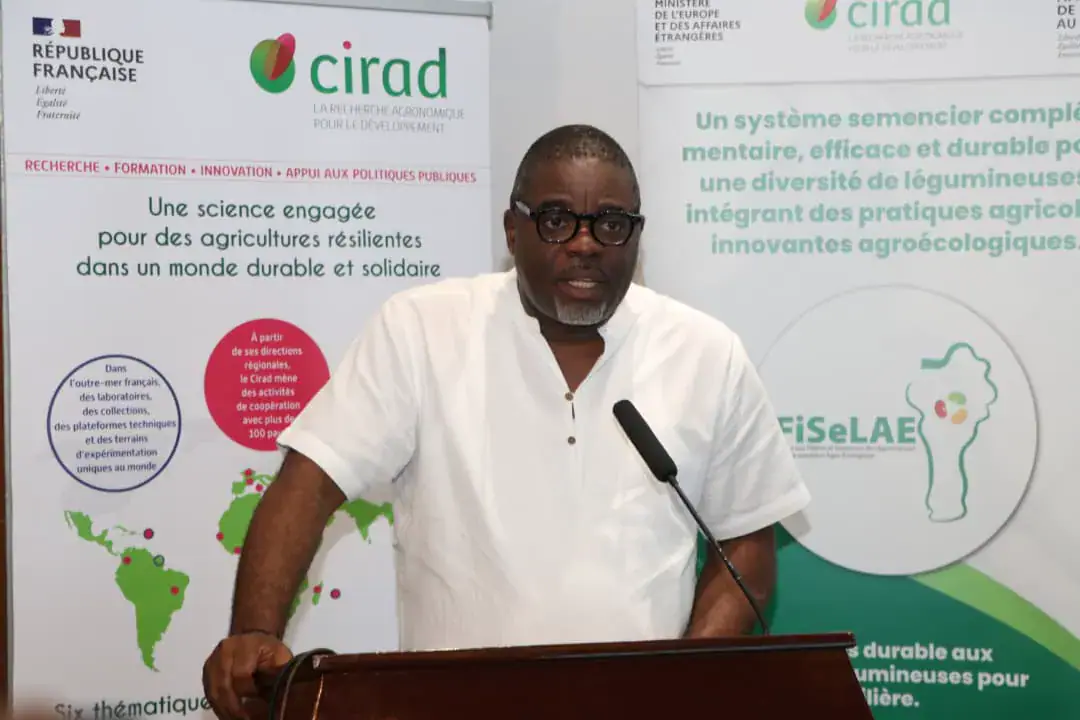
The project's closure workshop, held on November 20, 2026, in Cotonou, brought together various stakeholders and partners involved in its implementation. The workshop aimed to review the project's evaluation report and capitalize on its achievements. The project's coordinator, Lalaina Ranaivoson, expressed gratitude to partners, including the Institut de recherche pour le développement (Ird), the Association nationale des femmes agricultrices du Bénin (Anaf-Bénin), and the Université d'Abomey-Calavi (Uac).
The project focused on strengthening legume value chains, improving access to quality seeds, and promoting agroecological practices. It worked with over 1,000 producers, mostly women, and established 40 field schools in the five communes. The project also collaborated with the Institut national des recherches agricoles du Bénin (Inrab) to conserve and characterize a collection of legumes.
Lionel Briand, cooperation and cultural action advisor at the French Embassy in Benin, praised the quality of the partnership that enabled the project's implementation. He emphasized the crucial role of legume value chains in agroecological transition, food security, and empowering producers. Briand highlighted the need to ensure the continuity of activities and partnerships beyond the project's lifespan.
Marc Chillet, representing Cirad in Benin, presented the project's concrete achievements. Four significant results were noted, including the accompaniment of over 1,000 producers, establishment of 40 field schools, conservation and characterization of a legume collection, and proposal of four new mango varieties to the national catalog.
The project also supported groups of women and aimed to promote agroecological practices. The project's results are expected to inspire new initiatives, inform public policies, and encourage the adoption of innovations by agricultural stakeholders. The closure workshop provided a platform for stakeholders to discuss the project's achievements and plan for its continuity.
The project's outcomes are expected to have a lasting impact on Benin's agricultural sector, particularly in the areas of legume production and agroecology. The project's focus on empowering women and promoting sustainable agricultural practices aligns with the country's goals for agricultural development and food security. Key stakeholders will continue to work together to build on the project's achievements.
Key points
- The project FiSeLAE has concluded with promising results, including the accompaniment of over 1,000 producers and the proposal of four new mango varieties to the national catalog.
- The project's closure workshop aimed to capitalize on its achievements and plan for the continuity of activities and partnerships.
- The project's focus on empowering women and promoting sustainable agricultural practices aligns with Benin's goals for agricultural development and food security.