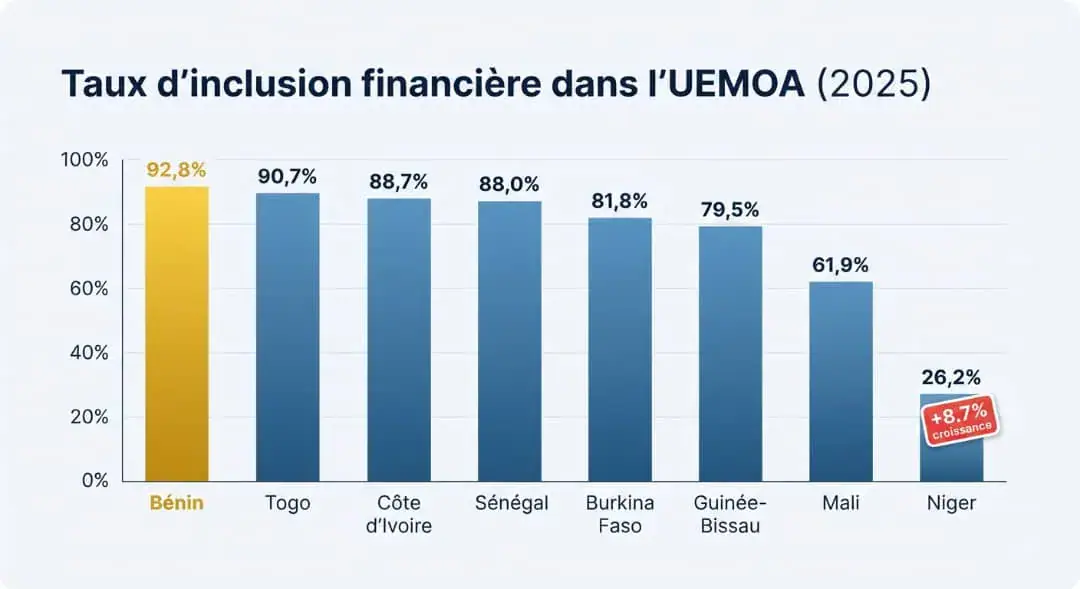
Benin has solidified its leadership in financial inclusion within the West African Economic and Monetary Union (UEMOA), boasting a record 92.8% inclusion rate. This achievement surpasses its regional peers, showcasing the country's progress in making financial services more accessible. According to the latest annual report from the Central Bank of West African States (BCEAO) for 2025, Benin retains its top spot.
The BCEAO report highlights that Togo follows closely with a 90.7% performance, succeeded by Côte d'Ivoire at 88.7%, and Senegal at 88.0%. In contrast, Burkina Faso records 81.8%, while Guinea-Bissau stands at 79.5%. Mali and Niger have lower rates, at 61.9% and 26.2%, respectively. Despite Niger's overall lower rate, it exhibits remarkable growth with an 8.7-point increase, attributed to strategic alliances between banks and electronic money issuers.
The introduction of interoperability services, known as "wallet-to-bank" and "bank-to-wallet," has facilitated bidirectional transfers between bank accounts and mobile wallets, significantly boosting mobile money usage in Niger. This upward trend is also observed across the UEMOA, albeit at a more moderate pace. Mali shows a 3.3-point increase, followed by Benin with 3.0 points, Senegal with 2.2 points, and Burkina Faso with 2.1 points.
Côte d'Ivoire ranks last with a 2.0-point increase. The overall financial inclusion within UEMOA continues its upward trajectory, surpassing the average of sub-Saharan Africa. This structural transformation is driven by the growth of digital finance and public-private synergy, making the West African model a notable example in democratizing financial services.
Benin's consistent leadership in financial inclusion is a testament to its effective strategies in enhancing accessibility to financial services. The country's approach has been influential in the region, with neighboring countries looking to replicate its success. The BCEAO's report underscores the importance of continued collaboration between financial institutions and governments to further improve financial inclusion.
The growth of mobile money and digital financial services has been pivotal in expanding financial inclusion across UEMOA. By fostering an environment conducive to innovation and investment in financial technology, member states can accelerate progress toward greater financial inclusion. This, in turn, can contribute to economic growth and development within the region.
As UEMOA continues to make strides in financial inclusion, the focus shifts to sustaining this momentum and addressing remaining challenges. The region's experience offers valuable insights for other parts of Africa and the world, highlighting the potential for collaborative efforts to enhance access to financial services and promote economic development.
Key points
- Benin's 92.8% financial inclusion rate leads the UEMOA region.
- Niger shows the most dynamic growth with an 8.7-point increase in financial inclusion.
- The UEMOA region's financial inclusion rate surpasses the sub-Saharan African average.