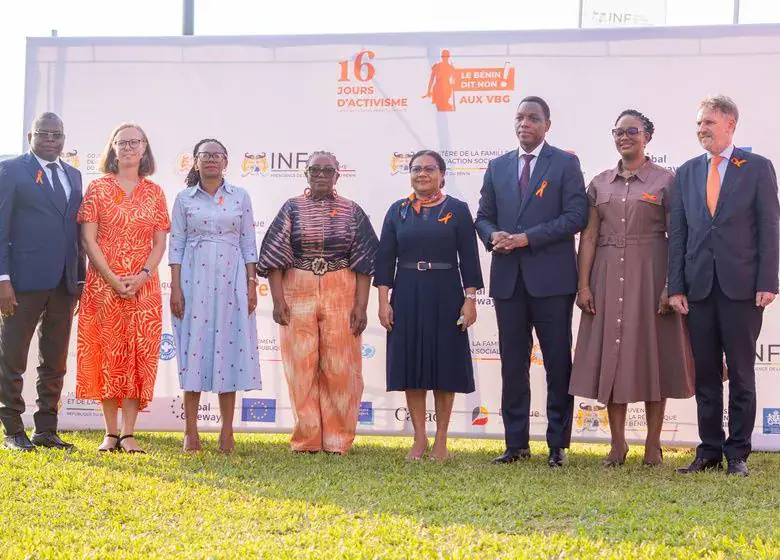
The Benin National Institute for Women (INF) has initiated its 16-day activism campaign against gender-based violence (GBV), emphasizing justice and victim protection. The campaign, launched by Minister of Family and Social Action Véronique Tognifodé, will run until December 10, 2026. This year's campaign highlights three main demands: ensuring access to justice, protecting survivors, and ending impunity.
According to INF President Huguette Bokpè Gnacadja, merely denouncing violence is insufficient; it's also crucial to address social mechanisms that prevent victims from speaking out and seeking redress. She shared a disturbing case of a young girl sexually abused by a trusted adult, only to face skepticism and blame from her family. This secondary victimization must be addressed, she stressed, calling for an end to practices prioritizing family reputation over victim protection.
The urgency of the situation is underscored by concerning statistics. INF's Secretary Executive, Flore Djinou, reported 13,775 complaints since the institution's inception, with 6,752 cases recorded between January and October 2026 alone. In comparison, 4,590 complaints were filed throughout 2025. Other national structures also report significant numbers, including 10,344 cases of violence against women recorded by the Ministry of Family and Social Action from January to September 2026.
The situation of children is equally worrisome. Data presented at the ceremony revealed 4,672 cases of sexual violence against minors in four departments covered by the Ministry of Primary and Maternal Education's program. INF's statistics show that sexual, economic, and physical violence account for 78.9% of cases recorded between September 2021 and October 2026. Sexual violence tops the list at 27.3%, while psychological violence also remains a significant concern.
The plight of minors draws particular attention. Among 1,565 judicial decisions examined by INF, 746 involve sexual acts against minors under 13, constituting 47.7%. Rape cases account for 236 decisions, or 15.1%. These two categories combined represent 72.8% of the decisions mentioned. Flore Djinou emphasized that these statistics represent real-life victims awaiting justice and reparations.
To give the campaign concrete impact, INF has planned 16 thematic discussions, to be addressed daily on its social media platforms, in the media, and through 24 community radios in 32 local languages. Topics will include victims' rights, child exploitation, sexual violence against minors, and digital violence. Sensitization sessions will also be organized for motorcycle taxi drivers in the country's 12 departments.
The campaign will conclude at INF's headquarters with the announcement of institutional commitments. First Lady Nathalie Villette Wadagni called for actions structured around four engagements: preventing violence and abuse of authority, facilitating confidential reporting, protecting and supporting victims, and following up on reported cases. The goal is to sustain this mobilization beyond December 10, ensuring institutions, families, and communities work to protect victims and hold perpetrators accountable.
Key points
- The campaign focuses on three main demands: ensuring access to justice, protecting survivors, and ending impunity.