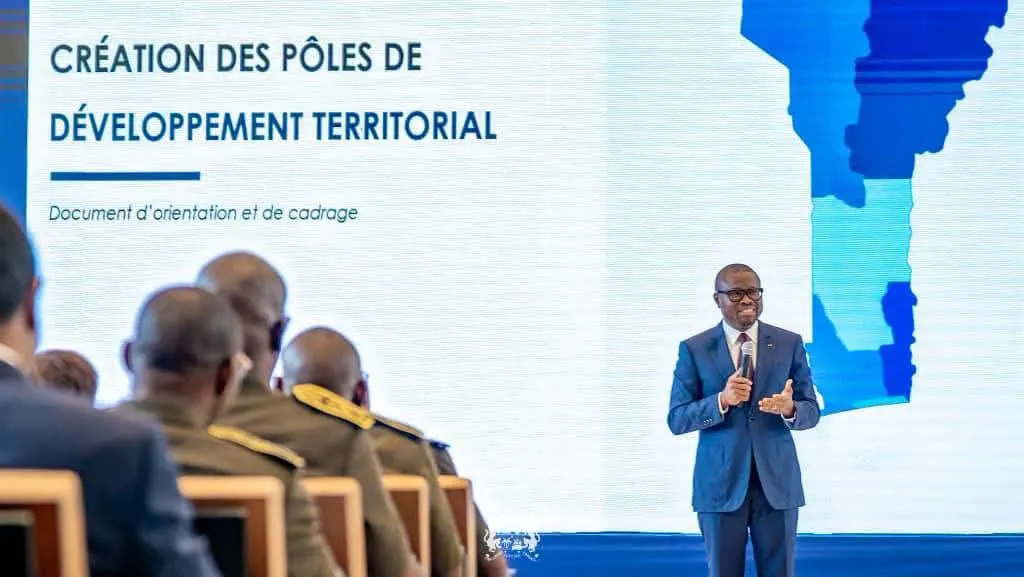
The Beninese government, led by President Romuald Wadagni, has introduced a reform aimed at creating six territorial development poles. This move is designed to address long-standing imbalances and build on proven achievements. The reform's primary goal is to create a more balanced and equitable distribution of economic growth across the country. By grouping 77 communes into six coherent ensembles, the government aims to create a critical mass that will enable the development of large-scale economic projects.
One of the key drivers behind this reform is the recognition that a single commune, even a dynamic one, lacks the scale to support major agro-industrial, logistics, or tourism projects. The new territorial development poles will provide a larger and more suitable framework for economic development. This will allow producers, such as pineapple farmers in the Plateau region, livestock farmers in the Borgou region, or food processors in the Couffo region, to operate in a larger and more viable space.
The reform also seeks to rebalance the country's economic growth map. Historically, economic activity in Benin has been concentrated around the coastal region, particularly in Cotonou, the country's economic hub. The new development poles aim to address this imbalance by promoting economic growth in the interior and northern regions. Each pole will be required to have at least one industry, one city, and one village designated for tourism development, as well as an innovation hub.
Another key aspect of the reform is its emphasis on building on existing strengths. Rather than starting from scratch, the government has chosen to leverage the progress made since 2016. This includes the professionalization of municipal administrations, national-level growth strategies, and cooperation between the state and communes. By preserving and connecting existing institutions, the government aims to create a more cohesive and effective system.
The design of the governance structure for the new development poles is also crucial. The government has sought to avoid the common pitfall of territorial reforms, which often result in confusion and overlapping competencies. Instead, the new poles will be designed to add value without duplicating or conflicting with existing powers. This will enable more effective coordination and cooperation between different levels of government and stakeholders.
The introduction of the six territorial development poles is part of a broader effort to deliver on campaign promises and create tangible results for Benin's population. The government has committed to transforming national ambitions into visible outcomes for citizens. By creating new opportunities for economic growth and development, the government hopes to improve living standards and quality of life for Beninese people.
The success of this reform will depend on effective implementation and coordination. The government will need to ensure that the new development poles are well-equipped to drive growth and development, and that they are able to address the needs and concerns of local communities. With careful planning and execution, the six territorial development poles could become a key driver of economic growth and development in Benin.
Key points
- The creation of six territorial development poles aims to address regional disparities and stimulate economic growth in Benin.
- The reform seeks to rebalance the country's economic growth map and promote development in the interior and northern regions.
- The government has chosen to build on existing strengths and leverage progress made since 2016 to ensure the success of the reform.