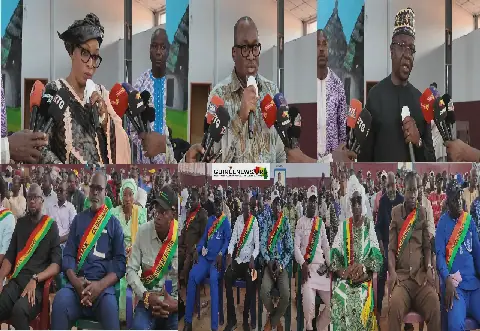
The Confederation of African Football (CAF) has initiated the evaluation process for the joint bid by Benin and the Alliance of Sahel States (AES) countries to host the 2030 Africa Cup of Nations (CAN 2030). A CAF delegation, led by Emmanuel Newton Dasoberi, a professional football manager, recently visited Burkina Faso as part of the evaluation process. The team assessed the country's capacity to host a major competition like CAN 2030.
During their visit, the CAF delegation inspected several facilities, including the Stade du 4-Août, the COMET training center for the national team, and the Lancaster Ouaga 2000 hotel. The inspections aimed to evaluate the country's sports infrastructure, accommodation options, and human resources that could be mobilized for the tournament. The delegation also met with Annick Pikbougoum/Zingue Ouattara, the Minister of Sports, Youth, and Employment, to discuss the country's hosting capabilities and organizational capacity.
The evaluation process involves a comprehensive assessment of the candidate countries' readiness to host the tournament. The CAF delegation's visit was the first step in this process, focusing on infrastructure and logistical aspects. Further evaluation teams are expected to visit the region to examine additional aspects, such as security, information technology, infrastructure, and healthcare facilities. The Africa Cup of Nations is a major event that requires significant investment in infrastructure, security, and logistics.
The Africa Cup of Nations, established in 1957, is the primary football competition for national teams in Africa. Organized by CAF, the tournament has featured 24 teams in its final phase since 2019. Hosting the tournament poses significant challenges for the host countries, which must provide suitable infrastructure, accommodation, security, and logistical support. A successful bid requires meticulous planning and execution to ensure a memorable and well-organized event.
The joint bid by Benin and AES countries aims to leverage the strengths of each participating nation to create a robust and competitive hosting proposal. By pooling their resources and expertise, the countries hope to present a compelling case to CAF. The evaluation process will determine whether the joint bid meets CAF's requirements and standards for hosting the tournament.
CAF's evaluation process is thorough and rigorous, taking into account various factors that contribute to a successful tournament. The organization seeks to ensure that the host country can provide a safe, welcoming, and well-organized environment for teams, officials, and spectators. The outcome of the evaluation will be crucial in determining the host country for CAN 2030.
The hosting of CAN 2030 is expected to have a significant impact on the region, both economically and socially. A successful tournament can boost the local economy, promote tourism, and enhance the region's reputation as a major sports destination. Conversely, a poorly organized event can have negative consequences, including financial losses and reputational damage.
Key points
- CAF evaluates joint bid by Benin and AES countries to host 2030 Africa Cup of Nations
- Evaluation process assesses infrastructure, logistics, and hosting capacity
- Hosting CAN 2030 poses significant challenges for host countries, requiring substantial investment in infrastructure and logistics
Reporting sources
- CAN 2030 : la CAF évalue le projet de candidature commune des pays de l’AES · La Nouvelle Tribune