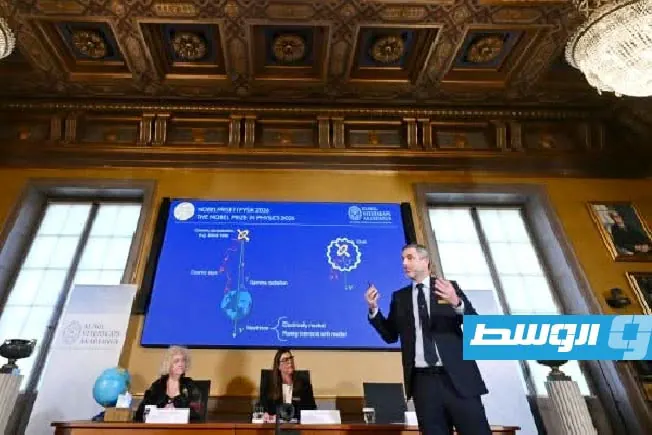
The Nobel Committee announced on Tuesday, October 6, 2026, that Francis Halzen, a 82-year-old Belgian physicist, has won the Nobel Prize in Physics. Halzen's research focused on subatomic particles at the South Pole, specifically his work with the IceCube Neutrino Observatory. The observatory, described as a kilometer-cube-sized block of ice equipped with light sensors, enables scientists to detect rare subatomic particles called neutrinos.
Halzen's contributions to the IceCube Neutrino Observatory were deemed "crucial" by the Royal Swedish Academy of Sciences. The observatory allows researchers to study high-energy neutrinos originating from distant astrophysical sources. According to Professor Eva Olson, a member of the Nobel Physics Committee, the prize recognizes Halzen's "decisive contributions to the IceCube Neutrino Observatory and the discovery of high-energy astrophysical neutrinos."
Born in the Belgian city of Tienen, Halzen is currently a professor at the University of Wisconsin-Madison in the United States. Upon receiving the news, Halzen expressed his surprise and delight, stating that winning the Nobel Prize was a "big surprise" he hadn't anticipated. The prize money for the Nobel Award has been increased to $1.21 million for 2026.
This year's Nobel Prize in Physics is the second to be announced, following the awarding of the Nobel Prize in Medicine on Monday to Karl Deisseroth, Peter Hegemann, and Jorg Nagel for their pioneering work in optogenetics. The Nobel Prizes continue to recognize outstanding contributions in various fields, promoting scientific excellence and innovation.
The IceCube Neutrino Observatory, located at the South Pole, is a unique facility that enables scientists to detect and study neutrinos. By analyzing data from the observatory, researchers can gain insights into high-energy astrophysical phenomena and the behavior of subatomic particles. Halzen's work has significantly advanced our understanding of the universe.
The Nobel Prize in Physics has been awarded to numerous scientists in recent years, including John Clauser, Michel Devoret, and John Martinis in 2025, and John Hopfield and Geoffrey Hinton in 2024. The prize continues to honor outstanding contributions in the field of physics, recognizing scientists who have made significant impacts through their research.
The 2026 Nobel Prize in Physics has been awarded to Francis Halzen for his groundbreaking work on subatomic particles at the South Pole. Key points include:
Key points
- Francis Halzen won the Nobel Prize in Physics for his research on subatomic particles at the South Pole.
- The prize recognizes his contributions to the IceCube Neutrino Observatory and the discovery of high-energy astrophysical neutrinos.
- The Nobel Prize in Physics is one of several prizes awarded annually to recognize outstanding contributions in various scientific fields.