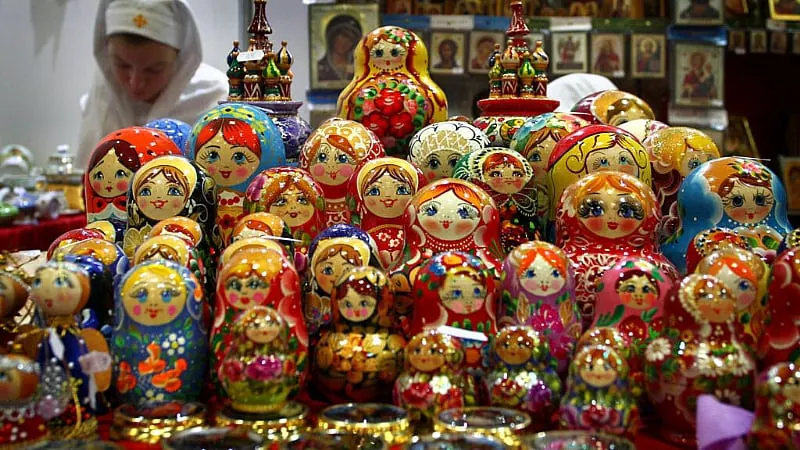
A group of Belarusian nuns from St Elisabeth's Convent have been selling traditional Russian items, including matryoshka dolls, at various French churches. The convent, which cares for orphaned children and provides social services, has been using the funds raised from these sales to support Russian troops. The nuns have been active in France, setting up stalls in different locations, including Val d'Or, Saint-Léon, Saint-Dolay, and Les Sables-d'Olonne.
The convent, led by Mother Superior, has been involved in fundraising campaigns for the Russian army since 2022. The funds have been used to purchase vehicles, equipment, and drones for the military. According to Natallia Vassilevitch, a Belarusian theologian, the convent's activities are carefully tailored to their audience, and they have built a network across Europe. The nuns speak several foreign languages and have registered organizations in Germany and Poland.
The convent's spiritual father, Archpriest Andrei Lemeshonok, has been a vocal supporter of the Russian invasion. In 2025, he declared that the convent was now a "combat unit" and was received at the Kremlin by Vladimir Putin, who awarded him the Pushkin Medal. Lemeshonok has also defended his support for Russians fighting in the war, echoing the views of Belarusian President Alexander Lukashenko, who visited the convent in 2023.
Despite the controversy surrounding the convent's activities, the nuns continue to make fundraising trips to France. However, some French priests have started to question their involvement. Father Antoine Nouwavi, head of the parish in Les Sables-d'Olonne, initially refused to welcome the nuns but later agreed after receiving a letter from the Mother Superior assuring him that the funds raised would be used exclusively for charitable causes.
The convent's activities have not gone unnoticed, and several European countries have taken a stricter approach. In Sweden, the Church has officially recommended that its parishes no longer host the nuns, while in Poland, the United Kingdom, and Switzerland, their stalls have been banned or closed down. In Germany, a member of the Bundestag has called for an investigation into their activities.
Christian Vision, an organization that has been documenting the convent's activities, has alerted church leaders in France to the group's involvement in supporting the Russian army. According to Vassilevitch, the number of communities willing to welcome the nuns has decreased since the allegations surfaced. The issue of visas being granted to the nuns has also raised concerns, given the current difficulties for Belarusians to obtain a Schengen visa.
The convent's activities have sparked concerns about the extent of their involvement in supporting the Russian army. With a network of organizations and supporters across Europe, the nuns have been able to raise significant funds for the military. As the conflict in Ukraine continues, the role of groups like St Elisabeth's Convent is likely to remain a topic of debate.
Key points
- The nuns of St Elisabeth's Convent have been selling traditional Russian items in French churches to fund Russian troops.
- The convent's activities have been documented by Christian Vision, which has alerted church leaders in France to their involvement in supporting the Russian army.
- Several European countries have taken a stricter approach, banning or closing down the nuns' stalls, and investigating their activities.