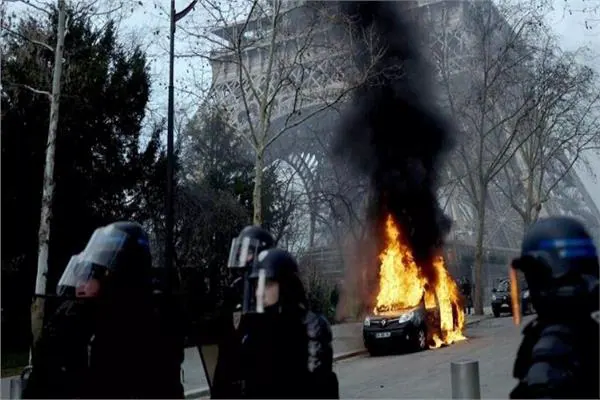
Belarusian Foreign Minister Maxim Ryzhenkov has attributed recent protests in several European Union countries, including France and Spain, to their support for the ongoing conflict in Ukraine. In an interview with the state-owned television channel, Ryzhenkov stated that the protests are a consequence of the policies pursued by EU elites, which prioritize military support for Ukraine over social welfare programs. This approach has led to a significant allocation of funds for armament, resulting in a shortage of resources for essential public services.
Ryzhenkov further explained that the diversion of funds for military purposes has negatively impacted various sectors, including healthcare, education, and infrastructure development. The minister emphasized that this has particularly affected vulnerable social groups and the overall quality of life in these countries. His comments come amid widespread protests in France, primarily driven by concerns over educational reforms, and similar demonstrations in Spain.
In France, high school students have been protesting for weeks against reforms that they claim undermine the education system. The protests, which have sometimes turned violent, have resulted in the arrest of over 6,800 people, mostly minors. The French authorities have estimated damages from the protests to be around €30 million. The situation has prompted concerns about the government's handling of the crisis and its impact on the country's social fabric.
The protests in France have shown signs of subsiding, with a noticeable decrease in the number of demonstrators and a shift towards more localized protests. According to the French Education Ministry, 141 educational institutions were closed on a recent Friday, with the majority located in the Île-de-France region, northern France, western France, and the Lyon suburbs. The ministry also reported that 86% of those arrested during the protests were minors.
The impact of the protests has been significant, with several regions estimating substantial financial losses. In the Auvergne-Rhône-Alpes region, the local president, Fabrice Beaucomb, announced plans to file a complaint after a projectile was thrown into a high school, injuring four staff members. The region has estimated damages and intervention costs related to the protests to be between €25 million and €30 million.
Similar incidents have been reported in other parts of France, including the city of Bordeaux, where a high school was vandalized, resulting in estimated damages of €200,000. The incident forced the temporary closure of the school. These events have raised concerns about the long-term consequences of the protests and the need for a resolution to the underlying issues driving the demonstrations.
Ryzhenkov's comments have sparked a debate about the EU's approach to the Ukraine conflict and its domestic priorities. While some have argued that the EU's support for Ukraine is essential for regional stability, others have expressed concerns about the economic and social costs of this policy. The situation remains a challenge for EU leaders, who must balance their commitment to supporting Ukraine with the need to address pressing social and economic issues at home.
Key points
- The protests in France and Spain are a result of their support for the Ukraine conflict, according to Belarusian Foreign Minister Maxim Ryzhenkov.
- The protests in France have resulted in significant damages, estimated at around €30 million, and over 6,800 arrests, mostly of minors.
- The EU's approach to the Ukraine conflict and its domestic priorities has sparked a debate about the need to balance support for Ukraine with addressing pressing social and economic issues at home.