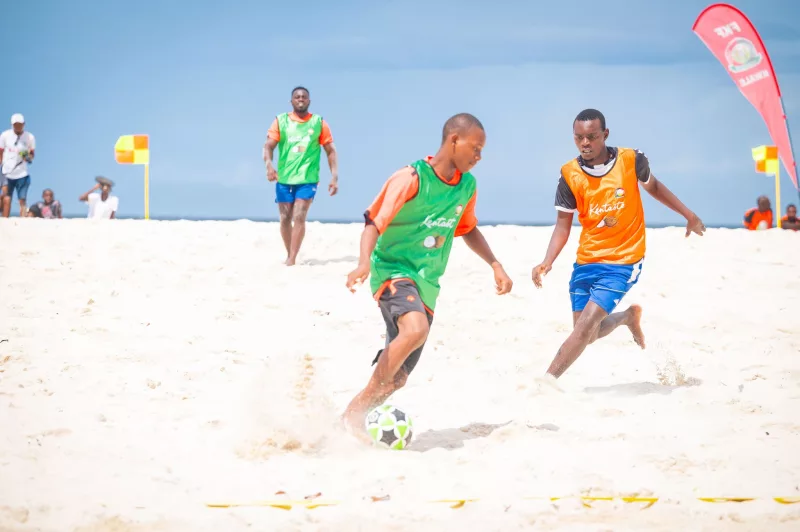
Beach soccer, a variant of association football played on sand, is rapidly gaining popularity in Kenya. The sport is being driven by the Football Kenya Federation (FKF), which manages the game through its Futsal and Beach Soccer Committee and regional branches. This has led to the creation of structured competitions and the nurturing of talent beyond the coastline. The FKF's efforts have made beach soccer one of the country's fastest-growing organised sports.
A professional beach soccer match is played with two teams of five players each, with unlimited rolling substitutions from a matchday squad of up to 12 players. The pitch is compact, measuring 35-37 metres long and 26-28 metres wide. The game is played on natural beaches or indoor sand arenas, making it possible to play all year round, regardless of weather conditions. This flexibility has contributed to the sport's growing popularity in Kenya.
One of the defining features of beach soccer is its specially designed ball. The ball is softer, lighter, and inflated to much lower pressure than a regular football, making it easier to control and allowing for spectacular bicycle kicks and volleys. The ball's water-resistant synthetic outer layer prevents it from absorbing moisture or heavy sand, making it ideal for playing on sand.
A professional beach soccer match lasts 36 minutes, divided into three 12-minute periods, with two three-minute breaks in between. The clock stops whenever play is interrupted, and there is no settling for a draw; if teams remain level after regulation, they contest a three-minute extra-time period, followed by penalty shootouts if necessary. This format guarantees that every match produces a victor.
The players' attire reflects the demands of competing on sand, with FIFA regulations requiring matching jerseys, shorts, and the option of long tracksuit bottoms for goalkeepers. Most importantly, every player competes barefoot, making balance, agility, and ball control crucial on the unstable surface. This unique aspect of the sport requires players to have a high level of skill and fitness.
Beach soccer has its origins in Rio de Janeiro, Brazil, in the 1940s. The modern era began in 1992 when Beach Soccer Worldwide formalised the Laws of the Game, laying the foundation for international competition. FIFA officially assumed global governance in 2005, launching the FIFA Beach Soccer World Cup and propelling the sport onto the world stage. Today, beach soccer is played in many countries around the world, including Kenya.
The growth of beach soccer in Kenya is a positive development for the country's sports sector. With its unique format and requirements, beach soccer offers a new and exciting opportunity for Kenyan players to showcase their skills. As the sport continues to gain popularity, it is likely that Kenya will produce more talented players who will compete at the national and international levels. The FKF's efforts to promote beach soccer are expected to yield positive results in the coming years.
Key points
- Beach soccer is rapidly gaining popularity in Kenya, driven by the Football Kenya Federation's efforts to promote the sport.
- The sport has a unique format, with a specially designed ball and a fast-paced game that requires a high level of skill and fitness.
- Beach soccer has its origins in Brazil and has been governed globally by FIFA since 2005.