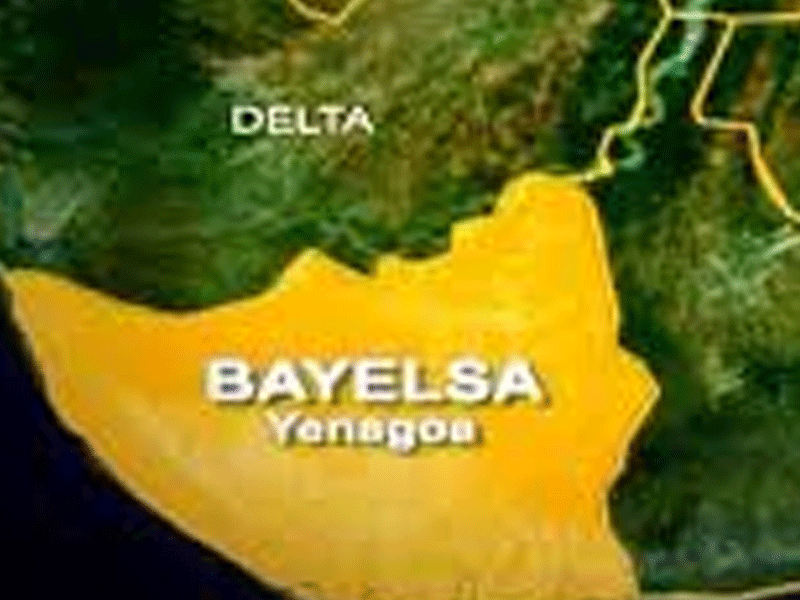
Bayelsa State, Nigeria's oil cradle, marked 30 years of existence on October 1, 1996, when a decree by General Sani Abacha carved it out of the old Rivers State. The new state inherited a capital with scarcely a road and eight local governments reachable mostly by boat. It also inherited one legacy no decree could alter: the swamp at Oloibiri where, 40 years earlier, Shell-BP struck Nigeria's first commercial oil.
The creation of Bayelsa State was a culmination of years of struggle by the Ijaw and other delta minorities for recognition and self-governance. Before the Willink Commission of 1958, they pleaded against permanent submersion in a federation of three large regions. Although the commission declined to create new states, it offered a "special area" and, in 1961, a Niger Delta Development Board, the first of many federal consolations that promised more than they delivered.
The line of struggle runs from Nembe's 1895 assault on the Royal Niger Company depot at Akassa, through Isaac Adaka Boro's 12-day republic in 1966, to Rivers State in 1967 and, at last, Bayelsa. Each episode posed the question Nigerian federalism has never settled: who should benefit from the wealth beneath the creeks? The Kaiama Declaration of December 1998 showed that statehood had not closed that question.
Despite being cash-rich, Bayelsa's capability to translate wealth into improved livelihoods for its citizens is poor. In the 2018/19 Nigeria Living Standards Survey, 22.6 per cent of Bayelsans fell below the monetary poverty line, far under the national 40.1 per cent. However, the 2022 Multidimensional Poverty Index found 88.5 per cent of Bayelsans deprived across health, education, living standards and work.
The state's fiscal fortunes are largely set by the price of Brent crude, not internally generated revenue. The 2026 budget of about N1.016 trillion draws roughly 83 per cent of its revenue from federation sources, with internally generated revenue under nine per cent. This has resulted in limited improvement in livelihood outcomes despite the circulation of money.
Over the past 30 years, Bayelsa has built some real infrastructure, including five universities, an airport, a specialist medical university, and roads to Oporoma and Ekeremor. The state also established an Oil and Environmental Commission in 2019, a rare act of moral leadership by a sub-national government. However, these outputs have not translated to significant outcomes for households.
Looking ahead, the global energy landscape presents challenges for Bayelsa. The International Energy Agency's central outlook sees world oil demand levelling off around 2030. For a producing state like Bayelsa, this uncertainty is a risk, making it essential to diversify and develop a sustainable strategy for the next 30 years, focusing on gas, an oil and gas industry it owns, and the water that is its permanent capital.
Key points
- Bayelsa State was created on October 1, 1996, from the old Rivers State.
- The state's fiscal fortunes are largely dependent on the price of Brent crude.
- Bayelsa has made significant investments in infrastructure, including five universities and an airport.