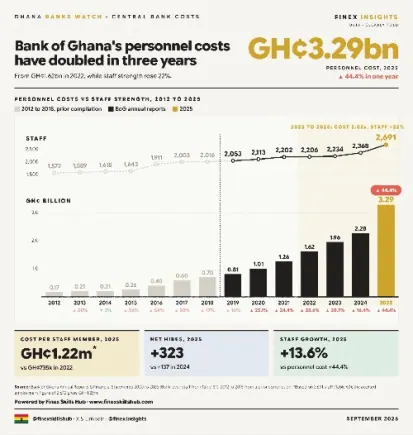
The Bank of Ghana's personnel costs have experienced a significant surge, increasing from GH¢1.62 billion in 2022 to GH¢3.29 billion in 2025, representing a growth of approximately 103 per cent. Over the same period, the bank's workforce grew from 2,206 to 2,691, an increase of about 22 per cent. This divergence between personnel costs and staff strength highlights a notable trend in the central bank's operating costs.
According to the Bank of Ghana's annual reports and audited financial statements, personnel costs rose steadily from GH¢1.26 billion in 2021 to GH¢1.62 billion in 2022, GH¢1.96 billion in 2023, and GH¢2.28 billion in 2024. However, 2025 saw a much larger jump, with personnel costs increasing by 44.4 per cent in a single year. The bank's human-resource report shows that staff strength rose from 2,368 in 2024 to 2,691 in 2025, an increase of 13.6 per cent.
The Bank of Ghana's Governor, Dr. Johnson Asiama, attributed the increase in personnel costs to changes in the bank's responsibilities and the need to recruit specialized skills. He stated that the bank was evolving and had taken on areas of work that previously received less attention, including monitoring virtual assets, data analytics, artificial intelligence, and cyber monitoring. These functions require additional personnel and new skills as the financial sector becomes more technology-driven.
Dr. Asiama also pointed to the cost of attracting and retaining specialized employees, stating that the bank had to remain competitive in its remuneration to prevent employees with skills in areas such as technology, data, and fintech from moving to other employers. This provides another possible explanation for why personnel costs have risen faster than staff numbers. The available figures show that the bank's workforce increased by about 22 per cent between 2022 and 2025, while personnel costs increased by about 103 per cent.
The increase in personnel costs is also reflected in the bank's broader operating expenses. The bank reported GH¢5.22 billion in other operating expenses in 2025, up from GH¢4.10 billion in 2024. Personnel costs alone accounted for about 63 per cent of the 2025 total, compared with approximately 56 per cent the previous year. The GH¢1.01 billion increase in personnel costs accounted for roughly 90 per cent of the year-on-year increase in this operating-expense category.
There is a small discrepancy in the Bank of Ghana's 2025 Annual Report, with the human-resource section reporting staff strength of 2,691 at December 2025, while the audited financial statements state that 2,672 persons were employed by the bank at the same date. The difference of 19 employees does not materially alter the overall trend, but clarification would improve consistency in the bank's public reporting.
Dr. Asiama indicated that the pace of recruitment would moderate after the recent expansion, and personnel costs were expected to decline in growth terms from 2026. He stated that the more useful measure was personnel cost relative to the bank's total operational costs rather than the absolute personnel-cost figure. The bank's internal benchmark is for personnel costs not to exceed 40 per cent of operational costs, and the Governor maintained that the current level was below that threshold.
Key points
- The Bank of Ghana's personnel costs have more than doubled in three years, driven by increased recruitment, new responsibilities, and the need for specialized skills.
- The bank's workforce grew by 22 per cent between 2022 and 2025, while personnel costs increased by 103 per cent.
- The Bank of Ghana's Governor expects personnel costs to decline in growth terms from 2026, with recruitment aligned more closely with annual retirements.