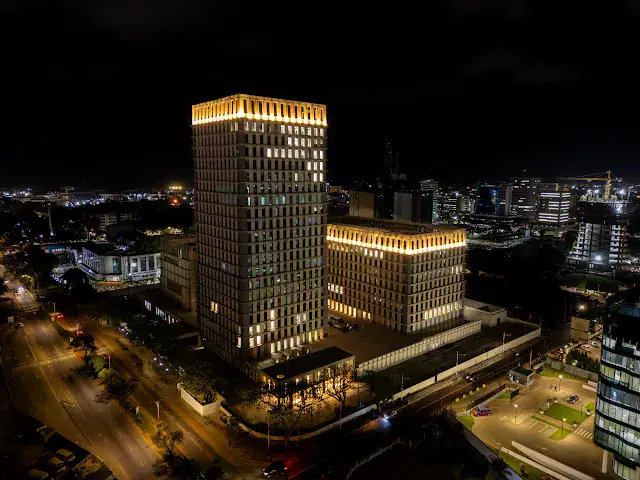
The Bank of Ghana has reduced its policy rate from 14% to 11%, Governor Johnson Pandit Asiama announced on November 18. This decision aims to bring the policy rate closer to the cost of borrowing between banks, which had been significantly lower. In October, banks lent to each other at an average rate of 10.2%, while the central bank maintained a 14% benchmark. The rate cut was made after a three-day meeting of the Monetary Policy Committee in Accra.
Alongside the 300-basis-point cut, the committee narrowed the range used to guide short-term interest rates. The upper limit was reduced to 12% from 18%, while the lower limit remains at 10%. The bank will also switch from a 14-day instrument to a seven-day one to manage the amount of cash in the banking system. This move is expected to increase demand for loans, as cheaper borrowing costs encourage businesses and individuals to borrow.
Commercial banks have responded by reducing their lending rates. In October, they charged borrowers an average of 15.8%, down from 22.2% a year earlier. The yield on Ghana's 91-day Treasury bill also decreased from 10.6% to 4.6% over the same period. These changes, along with the policy rate, determine the Ghana Reference Rate, which banks use as a starting point for pricing loans.
Lending to the private sector has grown significantly, increasing by 37.2% in the year to October, compared to 13.9% a year earlier. Even after adjusting for inflation, credit growth was 30%. The bank identified lending, exports, tourist arrivals, and construction as contributors to a 17.7% annual rise in its Composite Index of Economic Activity in September.
Despite the positive economic indicators, households reported decreased confidence in October due to higher fuel and transport costs. Business confidence, however, remained relatively stable. Firms surveyed by the bank cited higher costs for materials and other inputs but remained optimistic about their businesses and industries.
Inflation in Ghana has been relatively controlled, with an annual rate of 5.5% in October, up from 5.2% in September. Food prices rose more slowly, with food inflation easing from 4% to 2.8%, while non-food inflation climbed from 6.2% to 7.9%. The bank's core measure, which excludes energy and utility prices, also rose from 5% to 5.2%.
The government has managed its budget effectively, running a smaller deficit than projected for the first ten months of 2026. The deficit was 1% of gross domestic product, against a target of 3%. Domestic sources provided most of the financing, and excluding interest costs, the government recorded a surplus of 1.4% of GDP, close to its full-year target of 1.5%. The committee expects inflation to return gradually to its target range of 6 to 10%.
Key points
- The Bank of Ghana reduced its policy rate to 11% from 14% to stimulate economic growth.
- Lending to the private sector grew by 37.2% in the year to October, driven by cheaper borrowing costs.
- Inflation in Ghana remains controlled, with an annual rate of 5.5% in October, within the central bank's target range.
Reporting sources
- Bank of Ghana resets policy rate at 11% · Prime 9ja Online