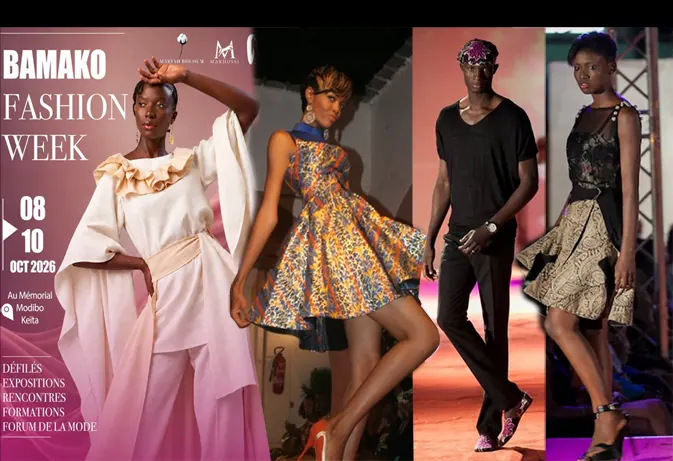
The third Bamako Fashion Week kicked off on October 8 at the Memorial Modibo Keïta in Bamako, Mali. The three-day event celebrates Malian creativity, cultural entrepreneurship, and local products. The opening ceremony featured a showcase of the country's rich cultural heritage, including the Défilé du Sahel, which highlighted regional creativity and craftsmanship. The event's theme, "Fashion as a Lever for Economic, Social, Cultural, and Environmental Development," underscores its goal of contributing to the professionalization of the sector.
The opening day of the event included an official visit to the creators' market, where artisans and designers showcased their work. A cocktail reception brought together fashion professionals, media, artisans, and the public. Officials and organizers emphasized the need to transform creative talents into concrete economic opportunities. Mariam Bocoum, founder of the event, stated that the objective is not only to celebrate the beauty of creations but also to build a stronger, more dynamic, and professional sector that can create value, jobs, and perspectives for Malian youth.
Bocoum also advocated for an eco-friendly fashion approach that benefits local communities. Mahamadou Diarra, Secretary General of the Ministry of Culture, shared her views, stressing that talent alone is not enough and must be accompanied by training, discipline, professionalization, and innovation. He called for stronger synergies between creators, investors, institutions, and media to support the growth of the sector.
The European Union's representative in Mali highlighted the significance of fashion beyond its aesthetic value, emphasizing its role in affirming national identity and contributing to the economy. He also underscored the importance of women and young people in the development and professionalization of the sector. The representative of Canal+ noted that fashion reflects a nation's heritage, influences, and ability to reinvent traditions and adapt to modernity.
Mali is one of Africa's leading cotton-producing countries, with a rich textile tradition, including bogolan, indigo, and weaving. However, local transformation of cotton remains limited, with less than 1% of cotton currently being processed locally, according to Mariam Bocoum. The event aims to address this challenge by mobilizing youth and sector actors to increase local transformation and better valorize the entire production chain.
The Bamako Fashion Week has evolved since its inception in 2011 as the "Chris Seydou Fashion Week." This third edition seeks to strengthen its African and international outreach, providing a platform for Malian fashion creators, artisans, and professionals. The event offers an opportunity for stakeholders to network, share ideas, and explore ways to support the growth of Mali's creative industry.
Key stakeholders, including government officials, international representatives, and industry experts, have expressed their support for the event and its objectives. By promoting local products, creative entrepreneurship, and eco-friendly fashion practices, the Bamako Fashion Week aims to contribute to Mali's economic, social, and cultural development. The event will continue to showcase Malian creativity and craftsmanship, highlighting the country's rich cultural heritage and its potential for growth and innovation in the fashion sector.
Key points
- The Bamako Fashion Week aims to professionalize Mali's fashion sector and increase local cotton transformation.
- The event promotes eco-friendly fashion practices and supports the growth of Mali's creative industry.
- Mali's rich cultural heritage and textile tradition are showcased during the three-day event.