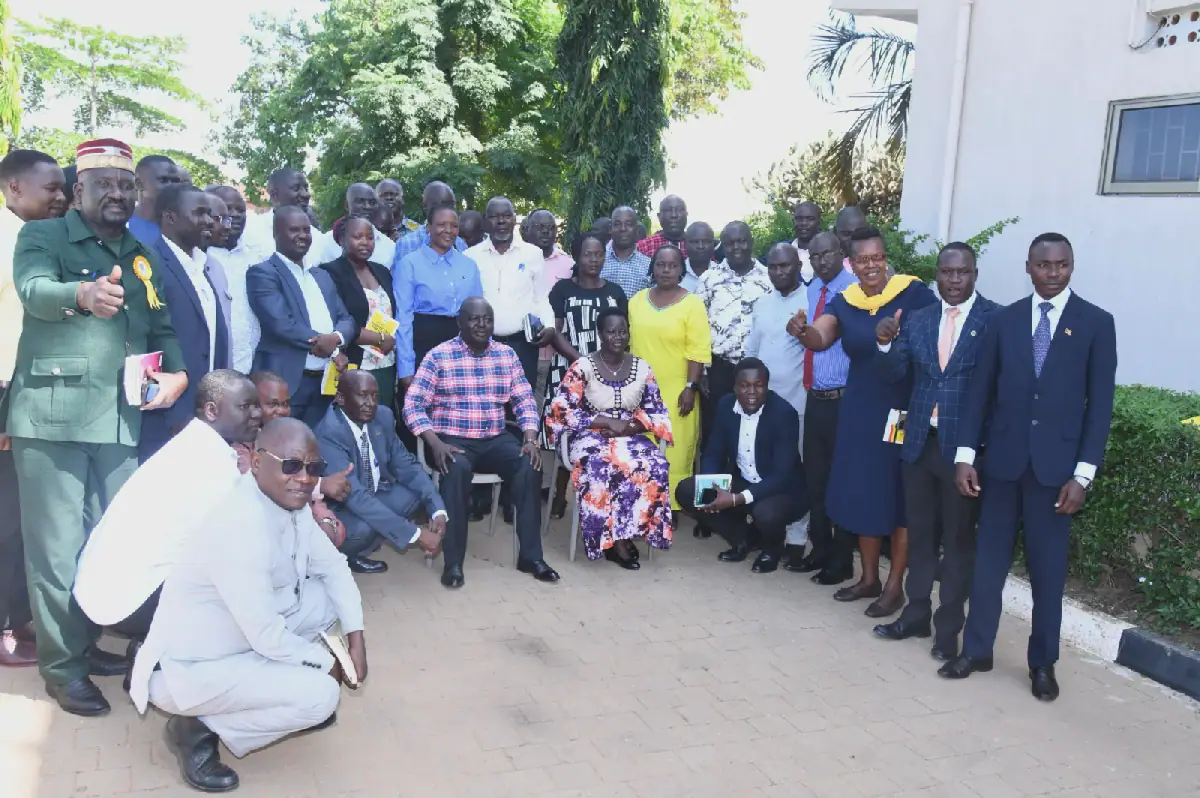
Minister for the Presidency Milly Babirye Babalanda has called on resident district commissioners and security officers in Teso to investigate complaints about government programmes, follow up on stalled projects, and account for public resources. Babalanda made the remarks through State Minister for Economic Monitoring Sandra Santa Alum at a three-day workshop in Soroti City. The workshop, which concluded on November 27, 2026, brought together resident district and city commissioners, their deputies and assistants, and regional and district internal security officers.
Babalanda emphasized the importance of diligence, discipline, integrity, and tangible results in the roles of RDCs and security officers. She stated that officers representing the President and central government must monitor public programmes, coordinate institutions, and provide reliable information to guide government decisions. This includes investigating complaints about government programmes, identifying those responsible, and recommending action.
The Minister also urged RDCs to make their offices accessible to all citizens, particularly women, young people, older persons, and persons with disabilities. She emphasized that people seeking help with land disputes, exclusion from government programmes, or abandoned public projects should receive guidance and follow-up. Babalanda cautioned officers against making promises outside their authority and urged them to establish facts and refer complaints to the responsible institutions.
Babalanda warned against confrontations with elected leaders and technical officers, emphasizing the importance of respecting their respective roles. She also called for timely, factual reports that clearly distinguish verified information from concerns requiring investigation. District internal security officers were urged to handle intelligence discreetly and provide analysis that helps authorities detect threats early and respond appropriately.
The Minister also emphasized the need for responsible use of government resources, including vehicles, equipment, and funds. Officers were cautioned against soliciting money, favours, or personal benefits from citizens and public institutions. Babalanda asked RDCs to work with technical staff, farmers' organizations, cooperatives, businesses, and development partners to address problems affecting production, storage, markets, and processing in Teso.
Marvin Ssenkungu, an economist in the Manifesto Implementation Unit at the Office of the President, discussed the NRM's 2026–2031 manifesto and its alignment with the Fourth National Development Plan and the government's Tenfold Growth Strategy. The strategy prioritizes agro-industrialization, tourism, mineral development, and science, technology, and innovation. Ssenkungu cited projected economic growth of between 6.5 and 7 per cent in the 2026/27 financial year, with further growth expected when commercial oil production begins.
The workshop aimed to equip RDCs and security officers with the skills and knowledge necessary to effectively monitor government programmes and address complaints in Teso. Babalanda's directives are expected to enhance accountability and transparency in the use of public resources in the region. The Minister's emphasis on investigating complaints and accounting for public funds reflects the government's commitment to good governance and service delivery.
Key points
- Babalanda urges RDCs to investigate complaints about government programmes and account for public resources.
- The Minister emphasizes the importance of diligence, discipline, integrity, and tangible results in the roles of RDCs and security officers.
- The NRM's 2026–2031 manifesto is aligned with the Fourth National Development Plan and the government's Tenfold Growth Strategy.
Reporting sources
- Babalanda urges Teso RDCs to investigate complaints and account for public funds · Uganda Broadcasting Corporation