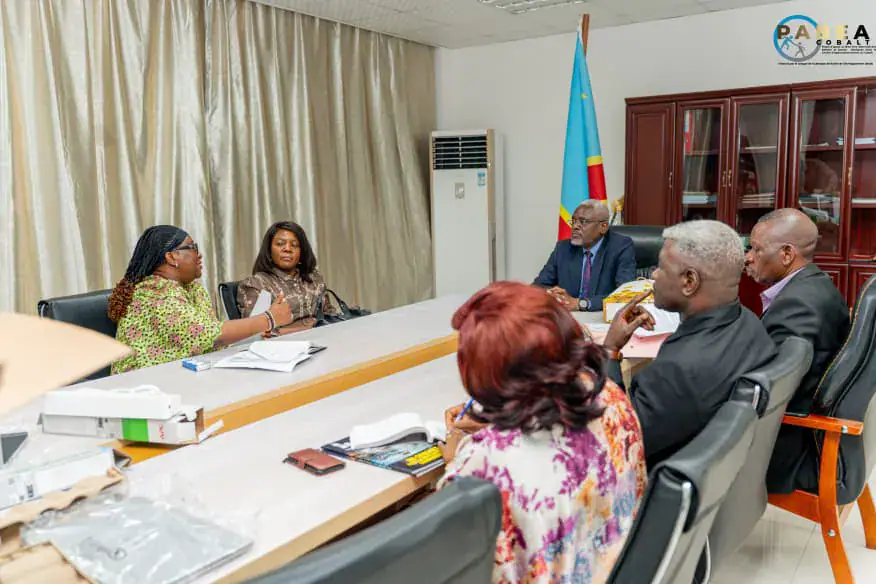
On November 11, national and provincial authorities gathered in Lubumbashi to evaluate the results of the PABEA-Cobalt project, which aims to combat child labor in artisanal cobalt mines. The project's first phase, funded by the African Development Bank (AfDB) with $84 million, is set to conclude on December 22, 2026. The meeting brought together key officials, including Alice Mirimo Kabetsi, Administrator General of the National Social Service Promotion and Social Fund (FNPSS), and Professor Youyou Baende Bofata, senior advisor to the President of the Republic.
The PABEA-Cobalt project, launched in 2019 at the initiative of President Félix Tshisekedi, has made significant strides in reducing child labor in cobalt mines. According to Alice Mirimo, 13,587 children have benefited from educational, health, and psychological support, as well as assistance with civil registration. The project's leaders claim that the results exceed expectations, with no children currently working in artisanal cobalt mining. A computerized monitoring and alert system, developed by the FNPSS, was also presented to the province to further enhance the project's impact.
The project has also led to the construction of 32 social infrastructure facilities, including 18 in Haut-Katanga and 14 in Lualaba. These include schools, health centers, and catch-up schools. Additionally, two Centers for Youth Entrepreneurship in Agribusiness (CPEJAB) have been established, aiming to create 6,000 jobs. The delegation visited the Mwabombemi Alice school complex in Mutumpeke, which was built as part of the project and now accommodates 450 students.
The school complex received educational kits, including notebooks, bags, uniforms, and geometry sets, during the visit. The school's director praised the project's impact, stating that it has helped rescue children from working in cobalt mines and return them to education. The project's focus on providing alternative economic opportunities to families living near mining areas is also seen as a crucial aspect of its success.
As the AfDB funding for the project is set to expire on December 30, 2026, the government has assured continuity of the project. According to Alice Mirimo, the achievements will be consolidated within the framework of the Integrated Emergency Community Development Program (PUIDC), while a second phase of PABEA-Cobalt is being prepared for 2027. The government has taken measures to ensure the project's sustainability.
The PABEA-Cobalt project aims to remove children from artisanal mining sites, support their education, and provide sustainable economic alternatives to families living near cobalt mining areas. With its focus on education and economic empowerment, the project has made significant progress in reducing child labor in the region. The project's impact is seen as a positive step towards protecting vulnerable groups and promoting social progress.
The evaluation meeting demonstrates the government's commitment to addressing child labor and promoting social welfare in the DRC. As the project moves forward, its success will depend on continued support and funding. The project's achievements serve as a model for future initiatives aimed at protecting vulnerable groups and promoting sustainable development in the region.
Key points
- The PABEA-Cobalt project has removed 13,587 children from artisanal cobalt mines, providing them with educational and psychological support.
- The project has constructed 32 social infrastructure facilities, including schools and health centers, in Haut-Katanga and Lualaba.
- The government has assured continuity of the project, with a second phase planned for 2027.