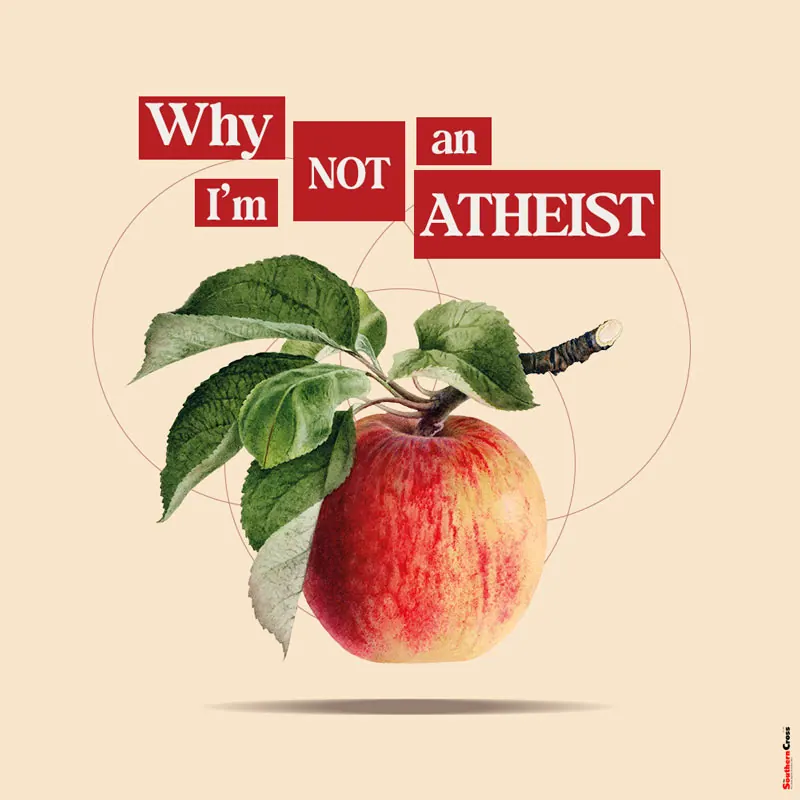
Jason Scott, a writer for The Southern Cross, has penned an article titled "Why I Am Not an Atheist: The Three M’s." In it, he shares his personal journey of questioning faith and steering away from passive agnosticism. Scott's reflections may be useful to those seeking to understand their own faith or simply curious about religion. He identifies three key areas where atheism falls short: Morality, Motion, and Maths.
Scott begins by addressing the issue of morality, a common argument against the existence of God. He notes that discussions about terrible events in the world assume a standard of how things ought to be. This, he argues, is a concept that atheism cannot fully explain. Citing CS Lewis, Scott points out that the idea of right and wrong cannot be derived solely from evolution. The "is-ought problem" remains unsolved among atheists, as it is impossible to derive a moral obligation from a factual statement.
The second area Scott explores is Motion, drawing from St Thomas Aquinas's five ways to prove the existence of God. Scott explains that St Thomas is not concerned with what started the universe but rather what sustains it. Using analogies such as a train and a phone charging on a desk, Scott argues that there must be something that does not borrow existence from another, something that simply is. This, he claims, is what St Thomas means by the first mover – not the initial cause but the ongoing sustainer of all existence.
Scott's third point relates to Maths, where he challenges the notion that atheism is the scientific position. He asks whether mathematics was invented or discovered. Given that mathematical truths seem to exist independently of human thought and are not subject to human instruction, Scott suggests that they must reside in an eternal mind. This leads him to conclude that an eternal truth requires an eternal thinker, making the alternative – that the universe is mathematical by sheer luck – seem like superstition.
Scott emphasizes that his arguments do not explicitly lead to Catholicism but rather aim to guide readers towards the existence of God. He plans to explore why Catholicism is the answer in a future article. For now, he invites readers to consider the implications of his arguments and the nature of faith.
The article has sparked interest among readers, with many appreciating Scott's thought-provoking insights. The Southern Cross Magazine, where the article was published, relies on readers' support to continue sharing such content. The publication encourages readers to subscribe or become associates to help spread the Good News.
Jason Scott's reflections offer a nuanced exploration of faith and atheism, highlighting the complexities of these philosophical debates. His article serves as a starting point for further discussion and reflection on the nature of existence, morality, and the role of faith in modern life.
Key points
- The author cites three main reasons for not being an atheist: Morality, Motion, and Maths.
- Scott argues that atheism cannot account for universal moral truths.
- He suggests that mathematical truths imply the existence of an eternal mind.