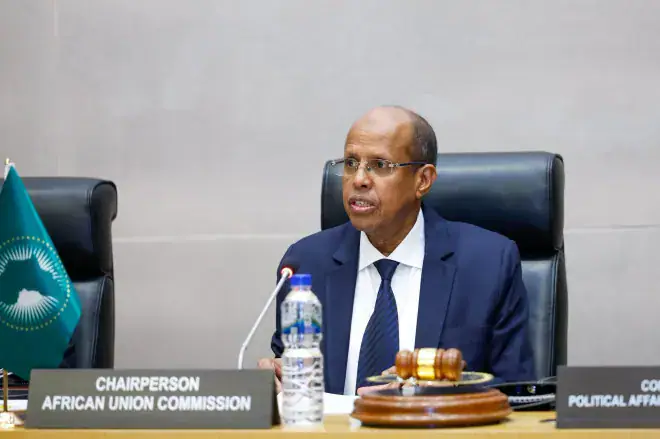
The African Union Peace and Security Council has endorsed a plan to gradually reduce its peacekeeping mission in Somalia through December 2027. The council approved the first two phases of a joint security transition plan developed by the African Union and Somalia's federal government. This plan outlines three stages: November to December 2026, January to December 2027, and a third phase beginning after 2027. The council warned that uncoordinated troop withdrawals driven by funding shortages could allow al-Shabab militants to recapture strategic towns and major supply routes.
The decision comes as the current mandates governing the African Union Support and Stabilization Mission in Somalia (AUSSOM) and the United Nations Support Office in Somalia (UNSOS) approach their December 31 expiration date. The AU stressed that the pace of the drawdown must reflect security conditions on the ground and the ability of Somali security forces to assume responsibility for areas currently protected by African Union troops. A withdrawal driven by funding shortages rather than security assessments could allow al-Shabab to retake strategic towns and major supply routes, potentially reversing years of military gains.
The council directed the AU Commission to develop clear guidance on the future of AUSSOM personnel, in consultation with Somalia's federal government and troop-contributing countries. It also called for detailed operational arrangements to ensure that military positions are transferred in an orderly manner to Somali security institutions or other designated security partners. As part of the transition, the AU Commission was instructed to conduct a joint strategic assessment with the Somali government and AUSSOM by September 2027.
The council also called for immediate diplomatic engagement to secure an extension of the UNSOS mandate until December 31, 2027, with sufficient resources to support the planned transition. UNSOS provides logistical and operational assistance to African Union troops and eligible Somali security forces, including support essential to sustaining military operations. The AU urged the United Nations Security Council, the European Union, AU Member States, bilateral partners, and the international community to provide financial and logistical support to AUSSOM.
The AU welcomed progress made by Somali security forces, supported by AUSSOM and international partners, in operations against al-Shabab. It cited joint operations known as Silent Storm and Rolling Thunder, as well as the transfer of five military locations, including forward operating bases, to Somali security forces. These developments demonstrate progress in transferring security responsibilities from African Union troops to Somali forces.
Beyond security, the council called on Somali political stakeholders to maintain dialogue and work toward a broad-based consensus on the country's state-building process. It welcomed President Hassan Sheikh Mohamud's engagement with political parties, civil society organizations, and other stakeholders ahead of national elections planned for 2027. The council reaffirmed its support for Somalia's sovereignty, unity, independence, and territorial integrity, rejecting external interference that undermines the country's stability.
The council also expressed concern about the potential humanitarian impact of El Niño in Somalia and urged international partners to increase assistance to vulnerable communities. The latest AU decision establishes a framework for reducing the mission's presence through 2027, but its implementation will depend on security assessments, coordination among troop-contributing countries, and continued international funding.
Key points
- The African Union Peace and Security Council endorsed a phased reduction of its peacekeeping mission in Somalia through December 2027.
- The council warned that uncoordinated troop withdrawals driven by funding shortages could allow al-Shabab militants to recapture strategic towns and major supply routes.
- The AU urged the United Nations Security Council to extend the UNSOS mandate until December 31, 2027, with sufficient resources to support the planned transition.