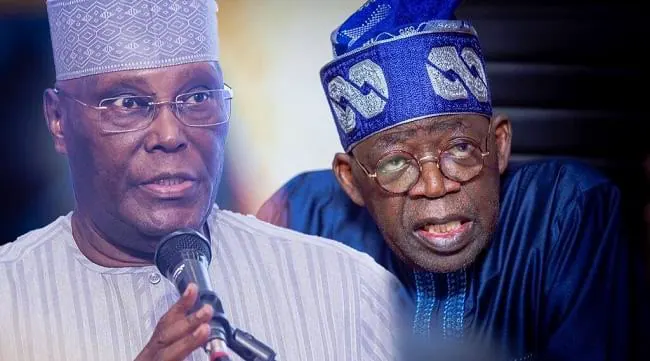
Former Vice President Atiku Abubakar has called on President Bola Ahmed Tinubu to provide a detailed account of Nigeria's borrowing and debt profile. In a statement issued by Phrank Shaibu, Director of Strategic Communications of the African Democratic Congress (ADC) Presidential Campaign Council, Atiku expressed concern over the country's rising debt and its impact on citizens. He noted that despite more than three years of reforms, Nigerians are facing higher food, transport, and energy bills.
According to the Debt Management Office (DMO), Nigeria's public debt stood at N166.79 trillion as of June 30, 2026, a significant increase from N49.85 trillion in March 2023. Atiku questioned the government's borrowing spree, stating that a government that claims to have more money coming in must explain why it continues to borrow and why citizens are not seeing the promised gains. He asked the President to provide a breakdown of old debt newly recorded, foreign debt whose naira value rose with the exchange rate, and new loans contracted since Tinubu assumed office.
Atiku emphasized that the debt question cannot be separated from the lived reality of ordinary Nigerians, who are struggling with the cost of living. Despite government reports of improving macroeconomic outcomes, many citizens are facing difficulties. The true test of economic policy, he said, is whether Nigerians can afford basic necessities like food, transportation, housing, education, healthcare, and electricity. He cited an IMF assessment in June 2026, which noted that while reforms have improved macroeconomic outcomes, conditions remain difficult, with poverty estimated at 63% under the national poverty line.
The IMF assessment also warned that higher fuel, food, and transport costs could worsen poverty, with 27 million Nigerians facing food insecurity in the latter part of 2025. Atiku pointed to recent fuel price pressures, with petrol selling at around N1,400 per litre in Lagos and Abuja and as high as N1,500 in parts of northern Nigeria in September. He also noted that diesel prices have exceeded N2,000 per litre. The cost of servicing debt has become a major concern, with a BudgIT report indicating that debt service reached N12.52 trillion in the second quarter of 2025, accounting for 67.2% of revenue.
Atiku also cited President Tinubu's remarks at the Africa Forward Summit in Nairobi in May, where he stated that Nigeria expected to spend about $11.6 billion on debt service in 2026, nearly half of projected revenue. He demanded disclosure concerning the DMO's external debt-service schedule for the second quarter of 2026, which recorded $39.25 million as 'other charges' between April and June 2026. Atiku asked for clarification on what the $22.5 million charge was for, which agreement authorised it, and the original facility.
Furthermore, Atiku requested a reconciliation of Treasury Bill borrowing, noting that the DMO reported N19.48 trillion outstanding Nigerian Treasury Bills at June 30, 2026. He urged the government to publish what subsequently matured, redeemed, rolled over, and what constituted new borrowing. Atiku said the administration should apologise to families facing hardship and account for revenues and borrowing. He emphasized that good economics must ultimately improve human life and that Nigerians have a right to demand a full account.
Atiku concluded by urging the Federal Government to reconcile borrowing, explain charges, show what sacrifice has produced, and focus on making life affordable. He stated that an apology is not too much to ask from a government under whose watch many Nigerians have been pushed into deeper economic distress. The ADC presidential candidate emphasized that the government must prioritize the welfare of its citizens and provide transparency in its economic dealings.
Key points
- Atiku Abubakar asks President Tinubu to clarify Nigeria's growing debt profile and address economic hardship faced by citizens.
- Nigeria's public debt stands at N166.79 trillion as of June 30, 2026, a significant increase from N49.85 trillion in March 2023.
- Atiku demands disclosure on debt servicing and borrowing, citing concerns over the cost of living and economic hardship.